Chinese Woman Escapes Kidnapping in Thailand After Jumping from Moving Vehicle
A 24-year-old Chinese tourist survives abduction in Thailand, jumping from a moving car to escape captors targeting tourists with romance scams.
Source: thepaper.cn
In an alarming case highlighting the growing risks facing tourists in Southeast Asia, a 24-year-old Chinese woman narrowly escaped abduction in Thailand by jumping from a moving vehicle. The incident, which occurred in September 2026, has exposed sophisticated criminal networks operating across borders, using romantic relationships as a lure to trap unsuspecting victims.
Key Details of the Incident
- The victim met a man online who claimed to be in Thailand and invited her for a trip, promising to arrange airport pickup. Upon her arrival at Bangkok's Suvarnabhumi Airport on September 28, she was met by individuals who quickly seized her phone and personal belongings.
- Within minutes of entering their vehicle, the woman found herself under guard with restricted movement. The captors, later identified as Thai nationals, were transporting her toward the Thai-Myanmar border when she made her desperate escape.
- As the vehicle traveled through Lampang province's Li District, the woman seized an opportunity when her guard was distracted. She opened the car door and jumped out while the vehicle was still moving, sustaining injuries in the process.
- Local residents discovered the injured woman and provided assistance, taking her to a medical facility. Meanwhile, the perpetrators fled with her belongings. Thai authorities were alerted the following morning and launched a joint investigation with local police.
- The investigation revealed that the suspects were from the border area of Tak Province, familiar with local routes. They attempted to evade detection by using secondary roads and switching vehicles during transport.
- Thai police successfully apprehended one suspect in Tak's Mae Ramat District, followed by another who had traveled to Chiang Mai, mistakenly believing the situation had cooled down.
- During interrogation, one suspect admitted to normally working as a farmer but taking on illegal border-crossing jobs during agricultural off-seasons, earning between 5,000 to 15,000 Thai Baht per assignment.

In-depth Analysis
This case represents a disturbing trend in transnational crime where romantic scams serve as entry points for more serious criminal activities. The operation appears to be part of a larger network orchestrated by a Chinese national "boss" who planned to extort ransom from the victim's family in China. The intended destination—the Thai-Myanmar border region—is known for its numerous scam compounds where victims are forced into online fraud operations.
The incident underscores the evolving nature of criminal exploitation in Southeast Asia, where traditional romance scams have evolved into sophisticated kidnapping and human trafficking operations. The Thai-Myanmar border has become particularly notorious for such activities, with criminal networks exploiting porous borders and limited cross-border law enforcement coordination.
China's embassy in Thailand has recently issued multiple warnings about similar cases, noting an increase in disappearances and abductions of Chinese citizens upon arrival. These incidents often involve false promises of high-paying jobs, business opportunities, or romantic relationships that turn into nightmares.
The successful rescue in this case demonstrates the importance of rapid response and cross-jurisdictional cooperation. However, the broader challenge remains addressing the root causes that allow such criminal networks to flourish, including corruption, weak border controls, and the digital anonymity that enables initial contact through social media platforms.
Looking ahead, we can expect increased scrutiny on tourist safety in Thailand and other Southeast Asian destinations. Law enforcement agencies may implement more rigorous screening procedures at airports and popular tourist areas, while tech companies face pressure to better monitor and prevent scam operations on their platforms.

Frequently Asked Questions
What precautions should tourists take when visiting Thailand? Travelers should exercise extreme caution when meeting people online, avoid sharing travel plans with strangers, and always inform someone trustworthy about their itinerary. Using registered transportation services and maintaining regular contact with family members can also enhance safety.
How common are such scams targeting Chinese tourists? While exact statistics are difficult to obtain, Chinese authorities have reported a significant increase in cases involving romance scams leading to kidnapping or forced labor, particularly in Thailand, Cambodia, and Myanmar. The Chinese embassy has issued multiple advisories warning citizens about these dangers.
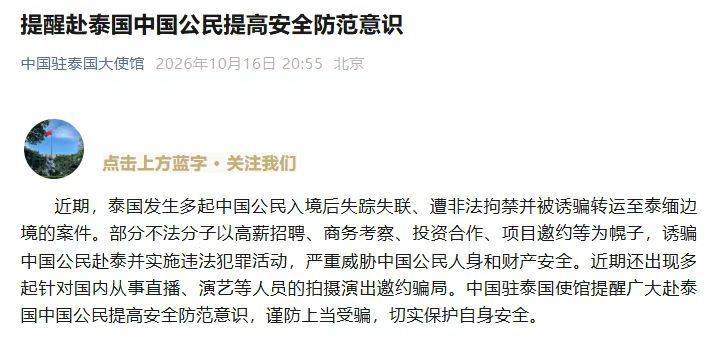
Source: https://www.thepaper.cn/newsDetail_forward_34333163
Related posts

China to Send Giant Panda Ranran to Belgium for Diplomatic Relations
To celebrate 55 years of diplomatic ties, China is sending giant panda Ranran to Belgium. This move aims to deepen bilateral cooperation in wildlife conservation.

Lula Wins Brazilian Presidential Election with 51.79% Vote
Luiz Inácio Lula da Silva secures narrow victory in Brazil's presidential runoff, securing his fourth term as president with 51.79% of the vote.

Xi Jinping, King Philippe Celebrate 55 Years of China-Belgium Relations
President Xi Jinping and King Philippe exchanged congratulatory messages, highlighting 55 years of strategic partnership and mutual respect.

Luxury Cruise Suites: The $25,000 Night Revolution in High-End Travel
Explore the booming luxury cruise market with suites costing up to $25,000 a night. Learn how elite travel is reshaping the industry and why space and privacy are the new currency.

Wonder's Bold Vision: Texas Expansion, Automation, and User-Built Restaurants Ahead of Potential IPO
Marc Lore's food tech giant Wonder plans aggressive Texas expansion, automation push, and user restaurant platform as it considers going public with $9B valuation.

Pepsi Extends Taco Bell Partnership Despite KFC's Switch to Coke
PepsiCo renews beverage deal with Taco Bell through 2036, days after sister chain KFC switches to Coca-Cola in strategic industry shift.

Brazil Presidential Election Runoff: Bolsonaro vs. Lula
The second round of the Brazilian presidential election begins. Two major political forces clash in a tight race.

China's Middle East Envoy Holds Key Talks with Saudi Diplomatic Advisor
China's special envoy for Middle East affairs meets with Saudi diplomatic advisor to discuss bilateral relations and regional stability amid ongoing geopolitical tensions.
Latest Articles
- Israel Election 2026: Netanyahu Faces Historic Protests and Tight Polls
- US Travel Alert: Middle East Security Risks Rise Amid Iran and Houthi Threats
- AI Safety Risks: Global Experts Share Solutions at 2026 Governance Forum
- UN Reform: China's 55-Year Commitment to Multilateralism
- Why Airlines Are Scrapping Brand-New Aircraft Amid Engine Shortage Crisis
- Comcast Exceeds Q3 Earnings Expectations as Media Strength Outweighs Connectivity Challenges