China's Battery Giants Dominate H1 2026: CATL Leads with 40% Global Share
In H1 2026, Chinese battery makers captured 72.4% of the global EV battery market. CATL alone holds nearly 40%. Financial highlights and strategic insights inside.
Source: 朱玉龙
The global electric vehicle (EV) battery market is undergoing a seismic shift, and the numbers from the first half of 2026 make it crystal clear: China is not just participating—it's leading. According to the latest data from SNE Research, Chinese companies accounted for a staggering 72.4% of global EV battery installations, with CATL alone claiming nearly 40% of the market. This dominance isn't just about volume; it's reshaping the economics, technology, and geopolitics of clean energy. Let's dive into the financial reports and market data to understand what's driving this trend and what it means for the rest of the world.
Key Highlights from H1 2026 Financial Reports
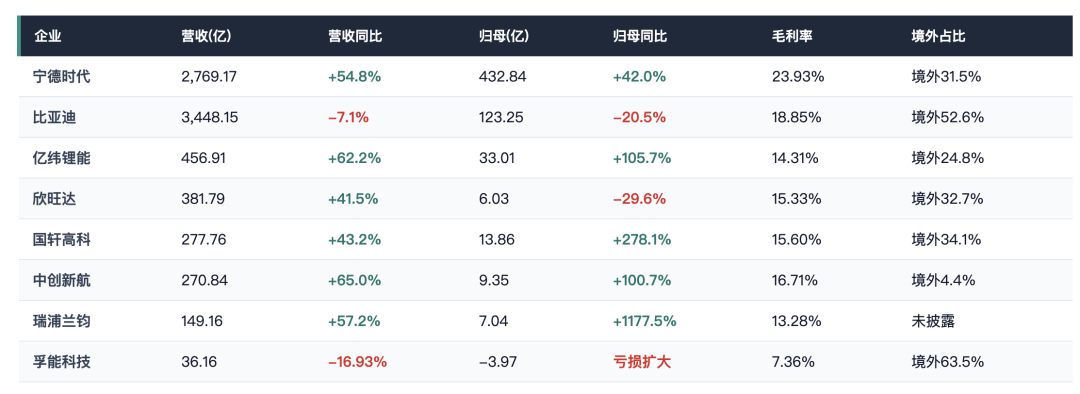
- Revenue Disparity: The combined H1 revenue of eight major Chinese battery companies (including CATL, BYD, and others) reached approximately ¥779 billion. CATL and BYD are in a league of their own with revenues of ¥277.6 billion and ¥344.8 billion (the latter including vehicles), respectively. In contrast, Farasis Energy lagged far behind with just ¥3.6 billion.
- Profitability Gaps: CATL posted a gross margin of 23.93% and net profit attributable to shareholders of ¥43.28 billion. BYD followed with an 18.85% margin and ¥12.33 billion net profit. Meanwhile, Farasis struggled with a mere 7.36% margin and a net loss of ¥397 million, highlighting the operational challenges for smaller players.
- Overseas Revenue Exposure: There's a clear divide in international presence. Farasis derived 63.5% of its revenue from overseas, while CATL (31.5%), Gotion High-tech (34.1%), and Sunwoda (32.7%) also showed healthy global footprints. CALB (Zhongchuang Xin Hang) was the outlier with just 4.4%, indicating heavy reliance on the domestic Chinese market.
- Shipment Volumes: EVE Energy reported total shipments of 80.22 GWh (35.76 GWh power + 44.46 GWh storage), while REPT (Ruipu Lanjun) shipped 42.7 GWh (15.5 GWh power + 27.2 GWh storage). Sunwoda's power battery shipments reached 28.36 GWh.
- SNE Research Installations: In terms of global installations (SNE basis), CATL led both power (242.7 GWh) and storage (125 GWh) categories. BYD followed with 87.7 GWh power and 35.7 GWh storage. CALB (31.2 GWh power), Gotion (28 GWh power), and EVE (20.9 GWh power) rounded out the top tier.
- Market Share Breakdown: CATL's 39.9% share, combined with BYD's 14.4%, gives the top two Chinese players a combined 54.3% of the global market. CALB (5.1%), Gotion (4.6%), and EVE (approximately 3.4%) add to China's collective dominance.
- Global Growth Context: Total global power battery installations grew 20% year-on-year to 608.5 GWh, while energy storage shipments surged 71% to 461.3 GWh. China's 72.4% share in power batteries is a testament to its manufacturing scale and technological edge.
- LFP vs. NCM Trend: The shift toward lithium iron phosphate (LFP) batteries is accelerating. In H1 2026, LFP usage in EVs grew 29.4% year-on-year, compared to just 10.1% for NCM (nickel-cobalt-manganese) batteries, underscoring LFP's cost and safety advantages for mass-market EVs.
In-Depth Analysis: The Strategic Implications of China's Battery Supremacy
China's dominance in the battery sector is not a stroke of luck but the result of years of strategic planning, supply chain integration, and aggressive R&D. The fact that Chinese companies now control over 70% of the global market has profound implications for automakers worldwide. First, it gives China significant pricing power and leverage in trade negotiations. Second, it accelerates the global transition to EVs by making batteries more affordable—LFP technology, which China has perfected, offers a cost-effective solution without compromising safety. However, this concentration also poses risks. Western automakers are scrambling to diversify their supply chains, leading to investments in local battery production in the US and Europe, such as Tesla's 4680 cells and partnerships with Korean firms. Yet, as the data shows, Korean and Japanese players are struggling to keep pace. LG Energy Solution's growth of just 8.4% (below the global average) and SK On's decline of 6.7% highlight their challenges in adapting to the LFP trend and weaker North American demand. Samsung SDI even dropped out of the top 10. The road ahead will likely see continued consolidation, with Chinese giants like CATL expanding overseas plants to circumvent tariffs and meet local content requirements. For the industry, this means a future where 'Made in China' batteries power the majority of the world's EVs, a scenario that underscores the urgent need for international cooperation and fair competition.
Frequently Asked Questions
Q: Why is CATL so dominant in the battery market?
A: CATL's leadership stems from its massive scale, continuous innovation in LFP and NCM chemistries, and strategic partnerships with major automakers. Its ability to produce high-quality batteries at competitive costs, coupled with a robust supply chain, allows it to maintain a market share of nearly 40%.
Q: What are the implications of China's 72.4% global share for non-Chinese automakers?
A: For automakers outside China, this concentration means potential supply chain vulnerabilities and higher dependency on Chinese suppliers. Many are responding by forming joint ventures with Chinese battery makers or investing in alternative technologies like solid-state batteries to reduce reliance on LFP and NCM from China.
Q: How does the LFP vs. NCM trend affect battery performance and cost?
A: LFP batteries are generally cheaper, safer, and have a longer cycle life, but they have lower energy density compared to NCM. The trend toward LFP in mass-market EVs reflects a trade-off between cost and range, which is acceptable for many consumers. Chinese companies have optimized LFP with structural innovations like CTP (cell-to-pack) to narrow the performance gap.

Source: https://mp.weixin.qq.com/s/fFzW7MeNY-mr-AlQnvgvCQ
Related posts
Volkswagen to Cut 100,000 Jobs: Inside the Biggest Automaker Restructuring
Volkswagen plans 100,000 job cuts, four German plant closures, and a halved model lineup by 2035 as profits collapse and China earnings shrink.

Alibaba Scrapped Its P-Level System: What It Means for Your Company
Alibaba dismantled its 19-year-old P-level hierarchy in 2023. Here's why high-level 'performers' drain profits, and how smaller firms can cut layers before it's too late.
China's 2026 Unicorn Rankings: AI Reshapes the Top 10
China ranks second globally with 381 unicorns. AI leads the 2026 list as ByteDance, Ant Group, and DeepSeek dominate. Explore the shifting landscape.

ByteDance Boosts AI Talent Incentives with Doubao Stock Hike
ByteDance raises Doubao stock price by 14.6% to retain AI talent, expands equity incentives, and integrates teams to accelerate AI adoption in the workplace.
Chinese Mobile Games Dominate Japan & Korea Q2 2026 Revenue Charts
Diandian Interactive's Whiteout Survival and Kingshot top Japan/Korea Q2 2026 revenue rankings. Market shows steady growth with iOS users spending 1.2x more. Full analysis inside.

Global Mobile Gaming Revenue Dips 1% in August: Why Mid-Tier Games Are Losing
Sensor Tower's August report reveals a $66M monthly revenue drop in mobile gaming. Top titles grow while mid-tier suffers. Insights on market shifts, regional trends, and what it means for developers.
China Southern Airlines Incheon Airport Ground Staff Recruitment 2026: A Gateway for Bilingual Talent
China Southern Airlines is hiring ground staff at Incheon International Airport for 2026. Learn about the role, requirements, and why this is a strategic opportunity for Korean-Chinese bilinguals.

Korea Coast Guard 2026 Chinese Translation Exam: Key Dates & Rules
Korea Coast Guard's 2026 3rd recruitment Chinese translation written exam set for Sept 5. Learn schedule, scoring, ID rules, prohibited items, and results date.
Latest Articles
- Social Security Benefits Boost, Russia-Ukraine War Updates, And Global Geopolitical Shifts
- COP17: Critical Moment for Biodiversity Framework Implementation
- Iran's Deep Involvement in Yemen Conflict and Egypt's Potential Military Intervention
- Haze from Kalimantan Forest Fires Reaches Jakarta Sky
- France Protests 2026: Mass Demonstrations Over Living Costs and Education
- Trump Signs Executive Order to Waive Key Sanctions on Russia Amid Energy Crisis