Global Mobile Gaming Revenue Dips 1% in August: Why Mid-Tier Games Are Losing
Sensor Tower's August report reveals a $66M monthly revenue drop in mobile gaming. Top titles grow while mid-tier suffers. Insights on market shifts, regional trends, and what it means for developers.
Source: 米老虎
When Sensor Tower released its August 2026 global mobile gaming report, the headline number was a modest 1% month-over-month decline in consumer spending, bringing the total to $6.57 billion across the App Store and Google Play. But behind that seemingly small dip lies a story of widening inequality: while the industry's biggest hits—many of them years old—continued to grow, the revenue loss was borne almost entirely by mid-tier titles that don't make the charts. This divergence offers a stark look at how the mobile gaming market is consolidating around a handful of live-service veterans, and why new entrants face an uphill battle.

Key Takeaways
- Global mobile gaming spending fell by roughly $66 million in August compared to July, a 1% drop to $6.57 billion. Sensor Tower only publishes the aggregate figure, but the implied July total is $6.636 billion, making the decline between 0.5% and 1.5%.
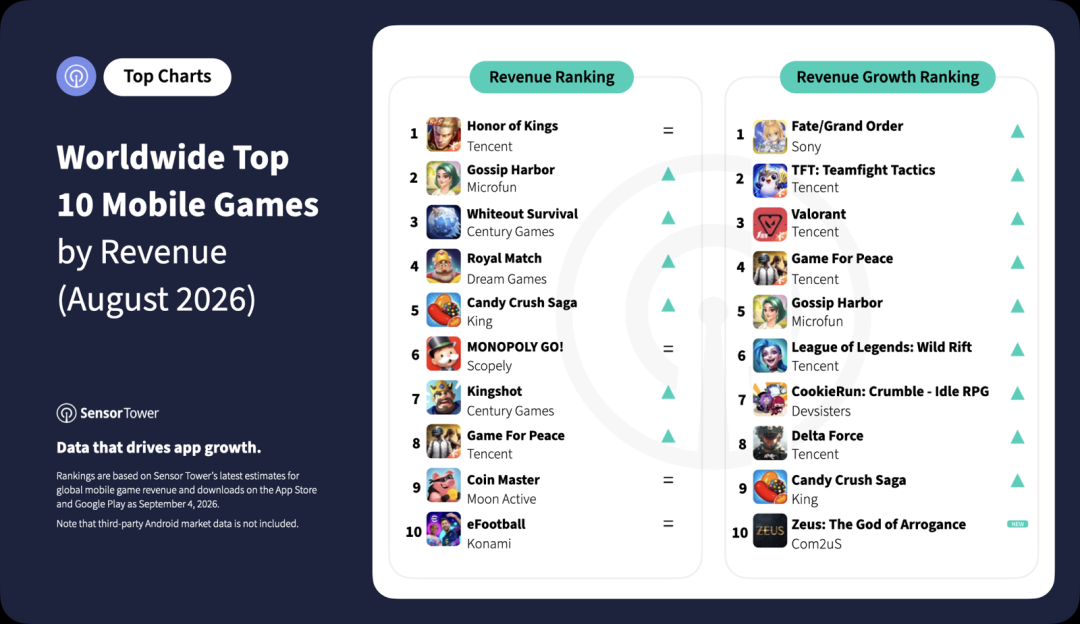
- The revenue top 10 showed remarkable stability: six games rose, four stayed flat, and none dropped in rank. Titles like Honor of Kings (Tencent) and Gossip Harbor (Microfun) held their positions, with Gossip Harbor even climbing to #2.
- The median age of the top 10 revenue earners is seven years, with Coin Master (Moon Active) at nearly 16 years old and Kingshot (Century Games) the only title launched after 2024, at just 18 months. This highlights the dominance of live-service veterans.
- Download growth is concentrated in emerging markets, with India leading at 16.4% of global downloads, followed by the U.S. (7.4%) and Brazil (5.8%). Meanwhile, the U.S. accounts for 28.6% of revenue, translating to $6.8 per download—3.9 times the global average.
- The revenue growth top 10 was dominated by live-service events: Fate/Grand Order hit its 2026 monthly peak thanks to its 11th anniversary in Japan, while Tencent titles like Teamfight Tactics and Valorant Mobile grew on new seasons and skins. Only one new game, Zeus by Com2uS, made the list.
- There is zero overlap between the revenue and download top 10 lists, underscoring that top-grossing games are not necessarily the most downloaded, and vice versa.
- The $66 million loss is attributed to mid-tier games that fall outside the top 10 in revenue and the growth chart. These titles are losing users to the aggressive event calendars of top games and struggling to monetize in emerging markets with low per-download value.

In-Depth Analysis
The August data paints a clear picture of a market bifurcating into haves and have-nots. The top 10 revenue earners are not just holding steady; many are growing, fueled by sophisticated live-ops strategies. For instance, Gossip Harbor ran six events back-to-back in August, including a fourth-anniversary celebration, demonstrating how established titles can squeeze incremental revenue from their existing user bases. Similarly, Fate/Grand Order's 11th-anniversary event in Japan drove its highest monthly revenue of 2026, proving that even decade-old games can spike with the right calendar.
Meanwhile, the growth in downloads is overwhelmingly coming from markets like India, Indonesia, Brazil, and Turkey—regions where per-download revenue is a fraction of that in the U.S. or Japan. This creates a paradox: the industry is adding users, but those users are not translating into equivalent spending. The U.S., with just 7.4% of downloads, generates 28.6% of revenue, while India, with 2.2 times the downloads of the U.S., contributes a negligible share that Sensor Tower doesn't even break out.
This divergence explains why the overall market contracted. The mid-tier games—those ranked 11th and below—are caught in a squeeze. They lack the brand equity and event cadence of top titles to retain whales, and they are not benefiting from the download surge in low-monetization markets. Essentially, the 1% decline is the mid-tier subsidizing the growth of the top tier.
Looking ahead, this trend is likely to accelerate. The success of Kingshot, which climbed into the top 10 just 18 months after launch, was driven not by organic growth but by a cross-promotion with its sibling game Whiteout Survival. This suggests that new entrants need the backing of a major publisher or an existing hit to break through. For independent developers, the barriers are higher than ever.
Moreover, the upcoming release of GTA 6 is already influencing mobile trends, with open-world crime games gaining traction in emerging markets. This indicates that mobile gaming is increasingly reactive to console and PC trends, creating both opportunities and threats for developers.
Frequently Asked Questions
Why did global mobile gaming revenue decline in August despite top games growing? The decline is attributed to mid-tier games that are losing revenue to the aggressive live-ops of top titles. While the top 10 grew through events and new content, mid-tier games lack the user loyalty and monetization strategies to compete, and they are not benefiting from download growth in low-spending markets.
What does the zero overlap between revenue and download charts mean for game marketing? It means that download rankings are not a reliable indicator of revenue potential. Games with high downloads in emerging markets may have low monetization, while games with fewer downloads in high-value markets like the U.S. can generate outsized revenue. Marketers should focus on revenue per download by region rather than raw download numbers.
How can new games break into the top revenue charts in this environment? New games need a strong publisher backing or a unique hook to gain traction. The example of Kingshot shows that cross-promotion with an existing hit can provide an initial boost. Additionally, targeting high-monetization regions with a polished game and a robust live-ops calendar from day one is crucial.
Source: https://mp.weixin.qq.com/s/bR29kzDXzAcOU3Rbine0GA
Related posts

Volkswagen to Cut 100,000 Jobs: Inside the Biggest Automaker Restructuring
Volkswagen plans 100,000 job cuts, four German plant closures, and a halved model lineup by 2035 as profits collapse and China earnings shrink.

Alibaba Scrapped Its P-Level System: What It Means for Your Company
Alibaba dismantled its 19-year-old P-level hierarchy in 2023. Here's why high-level 'performers' drain profits, and how smaller firms can cut layers before it's too late.

China's 2026 Unicorn Rankings: AI Reshapes the Top 10
China ranks second globally with 381 unicorns. AI leads the 2026 list as ByteDance, Ant Group, and DeepSeek dominate. Explore the shifting landscape.

ByteDance Boosts AI Talent Incentives with Doubao Stock Hike
ByteDance raises Doubao stock price by 14.6% to retain AI talent, expands equity incentives, and integrates teams to accelerate AI adoption in the workplace.
Chinese Mobile Games Dominate Japan & Korea Q2 2026 Revenue Charts
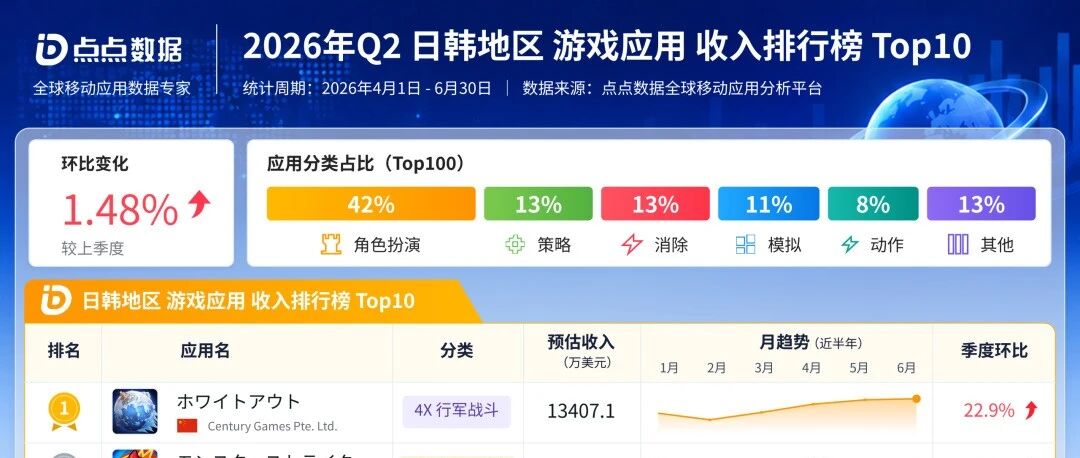
Diandian Interactive's Whiteout Survival and Kingshot top Japan/Korea Q2 2026 revenue rankings. Market shows steady growth with iOS users spending 1.2x more. Full analysis inside.

China Southern Airlines Incheon Airport Ground Staff Recruitment 2026: A Gateway for Bilingual Talent
China Southern Airlines is hiring ground staff at Incheon International Airport for 2026. Learn about the role, requirements, and why this is a strategic opportunity for Korean-Chinese bilinguals.

Korea Coast Guard 2026 Chinese Translation Exam: Key Dates & Rules
Korea Coast Guard's 2026 3rd recruitment Chinese translation written exam set for Sept 5. Learn schedule, scoring, ID rules, prohibited items, and results date.

Why Hypergryph Is the Most Desirable Game Studio in Shanghai
Hypergryph's new office, record-breaking revenue, and employee perks make it a standout in Shanghai's gaming scene. Explore the culture, success, and future of the studio behind Arknights.
Latest Articles
- JPMorgan Chase's $5 Billion Defense Strategy: Robot Factories & Hypersonic Missiles
- Netflix cuts 1,000 jobs as streaming growth slows and competition intensifies
- Shanghai's Cultural Renaissance: Festival, Theater, and Consortium Illuminate the City's Artistic Future
- High-and-Mighty Cabinet: More Officials Visit Yasukuni Shrine Amid Rising Controversy
- Oil Exports Plummet as Iran Increases Attacks in Strait of Hormuz
- Food Bank Lines Surge Ahead of Midterms: US Families Face Inflation and Welfare Cuts