G20 Foreign Ministers' Ends Without Consensus on Geopolitical and Economic Security
The recent G20 Foreign Ministers' Meeting concluded without joint communiqué amid deep divisions over Ukraine crisis, US-Iran tensions, and trade policies.
Source: thepaper.cn
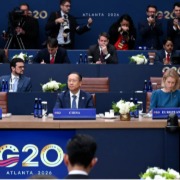
The two-day G20 Foreign Ministers' Meeting, which concluded on October 31 in Atlanta, Georgia, ended without reaching consensus on critical global geopolitical and economic security issues. The meeting took place under the shadow of ongoing conflicts in Ukraine and between the United States and Iran, ultimately failing to produce a joint communiqué due to persistent disagreements among member nations.
Key Takeaways
-
No Joint Communiqué: The meeting concluded without issuing a traditional joint statement, reflecting the deep divisions among participating nations on critical global issues.
-
Maritime Security Focus: US Secretary of Rubio emphasized the importance of ensuring freedom of navigation in strategic waterways like the Strait of Hormuz and the Black Sea, acknowledging that while all parties recognize the importance of these issues, significant work remains to find universally accepted solutions.
-
China's Security Initiative: Chinese Vice Foreign Minister Ma Chaoxu presented China's Global Security Initiative, advocating for a new approach to international security based on common, comprehensive, cooperative, and sustainable principles, emphasizing dialogue over confrontation, partnership over alliances, and win-win outcomes over zero-sum games.
-
Energy Security Concerns: The meeting highlighted growing concerns about global energy security, with rising fuel costs and increasing uncertainty in global trade markets, particularly regarding potential US military action against Iran following the midterm elections.
-
Diplomatic Tensions: The cancellation of the traditional 'family photo' during the meeting underscored diplomatic tensions, with several European nations, Australia, and Canada refusing to appear alongside Russian Foreign Minister Lavrov.
In-Depth Analysis
The outcome of this G20 Foreign Ministers' Meeting reflects the broader challenges facing global governance in an increasingly polarized international landscape. The failure to reach consensus on critical issues demonstrates how geopolitical rivalries are undermining multilateral institutions designed to address global challenges. The absence of a joint communiqué is particularly significant, as it marks a departure from the G20's traditional role as a forum for diplomatic consensus-building.
The meeting's focus on maritime security and energy affordability comes amid growing concerns about global supply chain disruptions and energy market volatility. These issues have been exacerbated by the ongoing conflicts in Ukraine and the potential for escalation in the Middle East, which could have profound implications for global economic stability.
Looking ahead, the upcoming G20 Leaders' Summit in Miami in December will be closely watched, particularly given President Trump's invitation to Russian President Putin. The absence of South Africa, last year's G20 chair, from this meeting has further complicated diplomatic relations within the group. The summit will test whether leaders can overcome the divisions that plagued their foreign ministers' meeting and find common ground on pressing global challenges.
Frequently Asked Questions
Why didn't the G20 Foreign Ministers' Meeting issue a joint communiqué?
The meeting failed to produce a joint communiqué due to deep divisions among member nations, particularly regarding the Ukraine crisis, US-Iran tensions, and trade policies. These disagreements were too significant to bridge during the two-day meeting.
What is China's Global Security Initiative mentioned in the article?
China's Global Security Initiative is a diplomatic framework that advocates for a new approach to international security based on common, comprehensive, cooperative, and sustainable principles. It emphasizes dialogue over confrontation, partnership over alliances, and win-win outcomes over zero-sum games in addressing international disputes.
What are the implications of the canceled 'family photo' at the meeting?
The cancellation of the traditional diplomatic photo session reflected significant diplomatic tensions, particularly between Western nations and Russia. Several European countries, Australia, and Canada refused to appear alongside Russian Foreign Minister Lavrov, indicating the deep divisions within the G20 on geopolitical issues.
Source: https://www.thepaper.cn/newsDetail_forward_34380252
Related posts

Spanish Train Crash: Viral Video is Old Footage, Not Pre-Disaster Footage
Fact-check reveals the viral video of a swaying train is from 2020, not the recent Toledo crash. Learn why misinformation spreads.
Binance Security Incident: $6.3 Billion Frozen After Hack
Binance confirms a significant security breach involving a compromised DevOps engineer's laptop. Over $6.3 billion in assets have been frozen by the exchange and stablecoin partners.

Binance $6.3B Crypto Heist: North Korean Cyber Warfare Explained
The massive $6.3 billion hack of Binance reveals the growing threat of state-sponsored cyber warfare and the regulatory gaps in the crypto industry.
AI Giants Face Critical Risks: Supply Chain and Technology Obsolescence
Explore the two most pressing challenges for AI companies like Anthropic: Taiwan's semiconductor dependence and the threat of outdated technology locking in expensive contracts.

Data Center Plans Threaten West Virginia's Wilderness and Dark Skies
A massive data center project in West Virginia raises concerns about environmental impact, light pollution, and the future of the region's pristine wilderness areas.

How Automakers Are Revolutionizing Manufacturing with 3D Printing
Ford, Rivian, and GM are democratizing 3D printing to cut costs, accelerate production, and transform automotive manufacturing processes.
Ukraine Expands Strikes, Russia Denies Progress: The Core Conflict Remains
As diplomatic talks loom in Abu Dhabi, Russia and Ukraine escalate military capabilities. Explore the stalled peace process and the deepening rift between Moscow and Washington.
EU-Canada 'Associate Member' Proposal: Ursula von der Leyen's Strategic Move Amidst Internal Divisions
EU Commission President Ursula von der Leyen pushes for Canada to become an associate member, a bid to strengthen ties amidst US trade tensions and geopolitical shifts, despite significant internal resistance from member states.
Latest Articles
- Poland's Constitutional Crisis: President Returns, PM Accused of Coup
- Global Perspectives on China's Party Discipline: Analysis of the 20th CPC Central Committee Fifth Plenum
- Starbucks Q4 2026 Earnings: U.S. Turnaround Gains Momentum Despite Missed Targets
- North Korea Linked to $6.3B Binance Hack: Cybercrime Analysis
- Budget Cars Flying Off Lots as Affordability Crisis Hits Auto Market
- South China Sea Tensions: China's Defense Ministry Responds to Philippine Actions