Nvidia Earnings Curse: Why Beating Estimates No Longer Moves the Stock
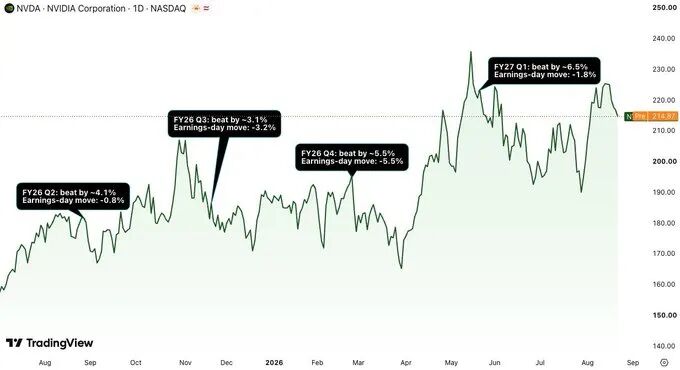
Nvidia has beaten earnings estimates for four straight quarters, yet its stock drops after each report. We analyze the 'expectations curse,' key catalysts like Q3 guidance and buybacks, and what it means for AI investors.
Source: 潇湘
Nvidia is set to report its fiscal Q2 2027 earnings after the bell on Wednesday, and investors are holding their breath. But here's the paradox that has come to define the chipmaker's earnings days: no matter how spectacular the numbers, the stock tends to fall. Over the past four quarters, Nvidia has consistently beaten Wall Street's estimates on earnings per share, revenue, and guidance—yet the shares have dropped the day after every single report. This phenomenon, which some have dubbed the 'earnings curse,' has left many investors scratching their heads. As the company's results become the single most important barometer for the entire AI trade, the stakes have never been higher. In this article, we'll dissect why Nvidia can't seem to win on earnings day, what could actually impress investors this time, and what it all means for the broader market.
Key Takeaways
-
The 'Beat and Drop' Pattern: Despite exceeding expectations on all major metrics for the past year, Nvidia's stock has declined the day after each earnings release. Bespoke Data shows that in the last four quarters, even when EPS, revenue, and guidance beat, the stock fell. This pattern suggests that the market's expectations have become so elevated that even a 'beat' is priced in.
-
The Guidance Trap: Analysts like Matthew Bryson of Wedbush Securities point out that because Nvidia has consistently beaten its own guidance for three years, the market automatically assumes the company will outperform any guidance it provides. This psychological dynamic means that even a strong forecast can be seen as underwhelming.
-
The AI Infrastructure Bet: Nvidia is not just a hardware supplier; it's also seen as the 'bankroller' of the entire AI infrastructure buildout. The company's financial health and capital allocation decisions have ripple effects across the tech sector, making its earnings report a proxy for the health of the AI boom.
-
Staggering Consensus Estimates: Wall Street expects Q2 EPS of $2.09 and revenue of $92.2 billion, but the real focus is on Q3 guidance. Cantor Fitzgerald notes the consensus for Q3 revenue is already at $103.7 billion, and analysts like Kevin Cassidy of Rosenblatt Securities say that guidance above $105 billion would be a 'huge surprise,' while $110 billion would be 'absolutely explosive.'
-
Capital Returns as a Catalyst: If Nvidia can't blow the doors off with its numbers, investors will look for signs that it's returning more cash to shareholders. CEO Jensen Huang has pledged to return 50% or more of free cash flow via buybacks and dividends, and analysts are watching to see if this commitment is reinforced.
-
The Vera Rubin Platform: News about Nvidia's next-gen AI chip platform, Vera Rubin, could also move the stock, though some experts question its near-term commercial viability. David Linthicum, former chief cloud strategy officer at Deloitte, notes that while the technology is impressive, questions remain about who will use it and at what price.
A Market Barometer: Nvidia's earnings are now seen as a bellwether for the entire AI-driven stock market. As Yi Fu Lee of Benchmark StoneX puts it, 'Nvidia is undoubtedly the weather vane for the entire AI industry. It's also my barometer for all SaaS stocks, because its performance directly reflects whether the real demand for GPUs in the semiconductor space remains strong.'
Deep Dive: The 'Expectations Curse' and What Could Break It
The 'expectations curse' is a classic case of 'buy the rumor, sell the news.' Nvidia's stock has surged over the past year, and investors have grown accustomed to mind-blowing results. As a result, the market's bar for 'beating expectations' has risen to near-impossible levels. Even when Nvidia delivers, the stock often falls because traders take profits or because the guidance isn't seen as strong enough to justify the lofty valuation.
But there are several catalysts that could break this curse. First, a Q3 revenue guidance above $105 billion would likely be seen as a genuine upside surprise. Second, a meaningful increase in capital returns—such as a larger buyback program or a dividend hike—could signal to investors that Nvidia is transitioning from a hyper-growth phase to a more mature cash-generating machine, much like Apple did when iPhone growth slowed. This could attract a new class of value-oriented investors.
Third, any positive news about Vera Rubin, even if it's just a roadmap update, could reignite excitement about Nvidia's long-term prospects. However, as Linthicum points out, the technology may be ahead of actual demand, which could limit its immediate impact.
Looking ahead, the broader market's reaction to Nvidia's earnings will be telling. If the stock falls despite a strong report, it could signal that the AI trade is becoming overheated. Conversely, if the stock rises, it could mean that the market is still hungry for AI exposure. Either way, Nvidia's earnings have become a macro event that transcends the company itself.
Frequently Asked Questions
Why does Nvidia's stock drop after beating earnings?
The market's expectations have become so elevated that even a 'beat' is often not enough to satisfy investors. Additionally, many traders use earnings day as an opportunity to take profits after a big run-up, leading to a sell-the-news reaction.
What should investors watch for in this earnings report?
Besides the headline EPS and revenue, pay close attention to Q3 revenue guidance—anything above $105 billion would be a positive surprise. Also, watch for any announcements about share buybacks or dividend increases, as these could signal a shift in capital allocation priorities.
How does Nvidia's earnings affect the broader tech market?
Nvidia is a bellwether for the AI industry. Its results and guidance provide insight into the demand for AI hardware, which in turn affects the entire tech supply chain, from cloud providers to software companies. A strong report can boost sentiment across the sector, while a weak one could trigger a sell-off.



Source: https://mp.weixin.qq.com/s/Vs1VjAscmgZ2iHx5U4kdzQ
Related posts

Volkswagen to Cut 100,000 Jobs: Inside the Biggest Automaker Restructuring
Volkswagen plans 100,000 job cuts, four German plant closures, and a halved model lineup by 2035 as profits collapse and China earnings shrink.

Alibaba Scrapped Its P-Level System: What It Means for Your Company
Alibaba dismantled its 19-year-old P-level hierarchy in 2023. Here's why high-level 'performers' drain profits, and how smaller firms can cut layers before it's too late.
China's 2026 Unicorn Rankings: AI Reshapes the Top 10
China ranks second globally with 381 unicorns. AI leads the 2026 list as ByteDance, Ant Group, and DeepSeek dominate. Explore the shifting landscape.

ByteDance Boosts AI Talent Incentives with Doubao Stock Hike
ByteDance raises Doubao stock price by 14.6% to retain AI talent, expands equity incentives, and integrates teams to accelerate AI adoption in the workplace.
Chinese Mobile Games Dominate Japan & Korea Q2 2026 Revenue Charts
Diandian Interactive's Whiteout Survival and Kingshot top Japan/Korea Q2 2026 revenue rankings. Market shows steady growth with iOS users spending 1.2x more. Full analysis inside.

Global Mobile Gaming Revenue Dips 1% in August: Why Mid-Tier Games Are Losing
Sensor Tower's August report reveals a $66M monthly revenue drop in mobile gaming. Top titles grow while mid-tier suffers. Insights on market shifts, regional trends, and what it means for developers.

China Southern Airlines Incheon Airport Ground Staff Recruitment 2026: A Gateway for Bilingual Talent
China Southern Airlines is hiring ground staff at Incheon International Airport for 2026. Learn about the role, requirements, and why this is a strategic opportunity for Korean-Chinese bilinguals.

Korea Coast Guard 2026 Chinese Translation Exam: Key Dates & Rules
Korea Coast Guard's 2026 3rd recruitment Chinese translation written exam set for Sept 5. Learn schedule, scoring, ID rules, prohibited items, and results date.
Latest Articles
- Used Car Prices Decline as Fuel Efficiency Demand Surges
- South Korea to Tighten Military Exemption Rules for Athletes
- South Korea's Former President Yoon Suk Yeol Acquitted in Political Funding Case
- Paramount Skydance Merger: A Historic Media Consolidation
- British Airways Expands Business Class to 106 Seats on A380: The Future of Luxury Travel
- Cheapest & Most Expensive US Flights in November 2026