Leipzig Drone Attack: How Germany-Russia Ties Hit a New Low
A drone found near a Ukrainian cargo plane at Leipzig Airport has triggered a Germany-Russia diplomatic rupture, new EU sanctions talk, and a rethink of NATO's role in hybrid warfare.
Source: thepaper.cn
A drone carrying explosives discovered beside a Ukrainian cargo aircraft at Leipzig/Halle Airport has escalated from a police investigation into one of the sharpest Germany-Russia confrontations in years. Within weeks, Berlin moved from technical forensics to formal political attribution, Moscow responded with consulate closures, and the European Union began sketching a new sanctions architecture. The episode matters far beyond one airport: it is a live test of how democracies attribute and deter "hybrid" attacks that deliberately stay below the threshold of open war.
Key Developments
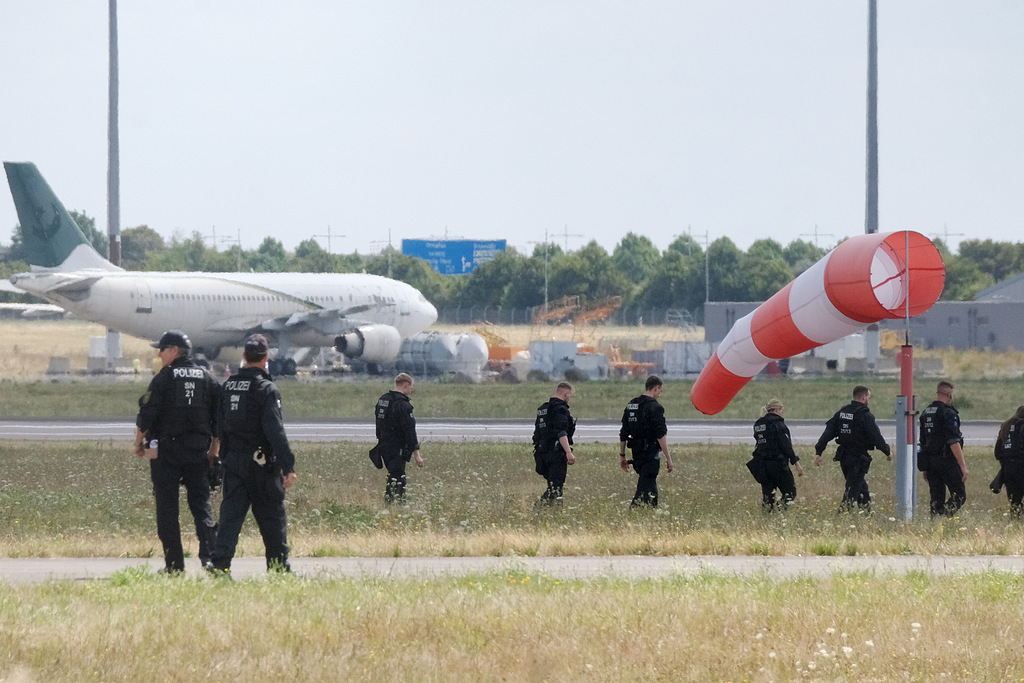
- The incident itself. On August 5, German police found an explosive-laden drone close to a Ukrainian transport plane at Leipzig/Halle Airport. The device was detected and defused in time, turning a potential catastrophe into a case study in hybrid tactics.
- Why this airport matters. Leipzig/Halle is not an ordinary civilian hub. It hosts a major DHL logistics center and, under NATO's Strategic Airlift International Solution, supports heavy airlift for NATO and EU members, including logistics for the alliance's eastern flank.
- Germany's attribution logic. Berlin said on September 1 that Russia was responsible, citing three pillars: the operational pattern and technical signature, police forensic findings, and intelligence holdings. Chancellor Friedrich Merz called the attribution "clear, indisputable and legally sound."
- Russia's countermeasures. Moscow demanded the closure of Germany's Consulate General in St. Petersburg by September 18 and the shutdown of Goethe Institute operations, with staff required to leave by September 13. Foreign Minister Sergei Lavrov said Germany was "effectively declaring war" on Russia.
- Europe widens the frame. EU foreign ministers discussed the case at an informal meeting in Ireland. European Commission President Ursula von der Leyen pledged more pressure and possible new sanctions, while EU foreign policy chief Kaja Kallas described the incident as "state-sponsored terrorism."
- A multi-track German response. Berlin closed Russia's Consulate General in Bonn, ended cooperation with the Berlin "Russian House," tightened entry screening for Russian citizens, pushed for EU sanctions listings tied to hybrid attacks, and stepped up scrutiny of Russia's "shadow fleet."
- NATO's role stays defensive. Germany has not invoked Article 5 or sought collective defense activation. The emerging division of labor casts the EU as the cost-imposing regulator and NATO as the defensive shield.
In-Depth Analysis
The most consequential shift here is legal and procedural, not military. Traditional criminal justice demands a publicly demonstrable chain of command, but hybrid operations are built to sever exactly that link through proxies, third-country nationals, online platforms, covert funding, and disposable recruits. European governments are therefore converging on a new standard: cross-validating behavioral patterns, personnel networks, technical signatures, intelligence, and past operational records to reach a political attribution before any court delivers a verdict. Berlin's insistence on separating political attribution from criminal investigation is the clearest codification of that doctrine to date.
The second shift is institutional. Once Germany completed attribution, the case migrated from a national security file to a shared EU agenda, and the response toolkit expanded from expulsions to visa screening, sanctions listings, financial and shipping enforcement, and critical infrastructure hardening. Germany's announced national "cyber dome" — a tightly linked sensor network meant to detect and intercept intrusions — signals that defense ministries, not just foreign ministries, now own this file. The likely trajectory runs from sanctioning individuals to sanctioning networks, then to supply-chain controls, and finally to infrastructure security standards.
Crucially, escalation remains asymmetric by design. Russia's hybrid campaigns are calibrated to stay beneath the threshold that would trigger conventional war, and European planners know that answering every drone with military force would hand Moscow the escalation it wants. The emerging strategy is cost imposition plus defensive hardening: raise the political and economic price of hybrid action while improving drone interception, border monitoring, airspace warning, and infrastructure protection. That is deterrence by denial and by cost, not by retaliation.
The real spillover risk lies beyond Europe. If EU sanctions and security screening extend to third-country firms, suppliers, and critical technology sectors, governments and companies far from the Baltic will find themselves pulled into the Germany-Russia contest. For global businesses in logistics, shipping, semiconductors, and dual-use technology, the Leipzig case is a warning that compliance boundaries are being redrawn around hybrid warfare, not just around conventional export controls.
Frequently Asked Questions
Why did Germany attribute the attack without publishing full evidence? Berlin argues that intelligence sources cannot be exposed without destroying them, so it combined forensic findings, operational-pattern analysis, and classified information into a political judgment. This mirrors how several European states have handled suspected Russian sabotage and cyber incidents since 2022.
Does this mean NATO could be drawn into direct conflict with Russia? Not automatically. Germany has not invoked Article 5, and the anticipated NATO contribution is defensive: intelligence sharing, airspace surveillance, counter-drone capability, and protection of member territory. The EU handles sanctions and regulation, while NATO handles defense.
What should international companies watch next? Expect tighter scrutiny of supply chains, shipping fleets, and dual-use exports linked to Russia, plus new EU listings targeting hybrid-attack networks. Firms with exposure to European logistics or critical infrastructure should review sanctions screening and cybersecurity posture now.
Source: https://www.thepaper.cn/newsDetail_forward_34044250
Related posts

North Korea Holds Third Company Commanders Meeting Amid Military Reinforcement
Analysis of North Korea's recent military leadership gathering focused on strengthening company-level units and enhancing combat readiness.

NHK Documentary Exposes Secret 1978 Yasukuni Shrine Ritual
Newly released archival footage reveals the 1978 secret ritual that enshrined Class-A war criminals, exposing Japan's persistent historical revisionism.

Gen Z Candidates Tackle Housing Crisis in Midterms 2026
Young lawmakers from both parties are campaigning on solving the record-high cost of living. Explore how Gen Z is reshaping the housing debate.
Tibetan Plateau Earthquake: Analysis of the 7.0 Magnitude Quake and Post-Disaster Response
Expert analysis of the 7.0 magnitude earthquake in Baingoin, Tibet, examining its geological significance and the unique challenges of disaster response at high altitudes.

Meta's New Link Policy: Why Social Media Sites Want You to Stay
Meta is introducing paid plans to limit free hyperlink posting, a strategic move driven by the business model of keeping users engaged on platforms.

Darden vs. Chipotle: How Portfolio Diversification Impacts Restaurant Stock Performance in 2026
Why owning multiple brands like Darden and Brinker International outperformed single-chain giants like Chipotle and McDonald's in 2026. Analyzing the power of portfolio diversification.
High Fares And Fewer Passengers: Why Airlines Are Profitable Despite Lower Demand
As airfare surges and passenger numbers decline, major carriers prioritize yield over load factor, turning a high-price strategy into record profits despite fuel costs.

American Express Cuts 5% of Workforce to Accelerate AI Transformation
American Express announces workforce reduction of 5% to become more agile and prepare for AI integration, with a $336 million restructuring charge.
Latest Articles
- Israel Imposes Total West Bank Blockade After Hebron Attack
- Russia Starts Diesel Exports to US: Geopolitical Shifts Ahead
- Peru Allocates $1.8 Billion to Combat El Niño and Economic Headwinds
- Trump Demands SpaceX Lift Starlink Restrictions for Ukraine Amid Geopolitical Tensions
- Louvre, Orsay Museums to Close on Oct 24 Amid Paris Protests
- Moderna Cancer Vaccine Shows Promise Despite Stock Drop After Data Leak