Alibaba Cloud Growth Returns: 30% AI-Driven Surge, But Still Far from AWS
Alibaba Cloud revenue jumps 30% in H1 FY2026, driven by AI demand. But with EBITA margin at 9% vs AWS's 39%, and free cash flow turning negative, what's missing?
Source: Long
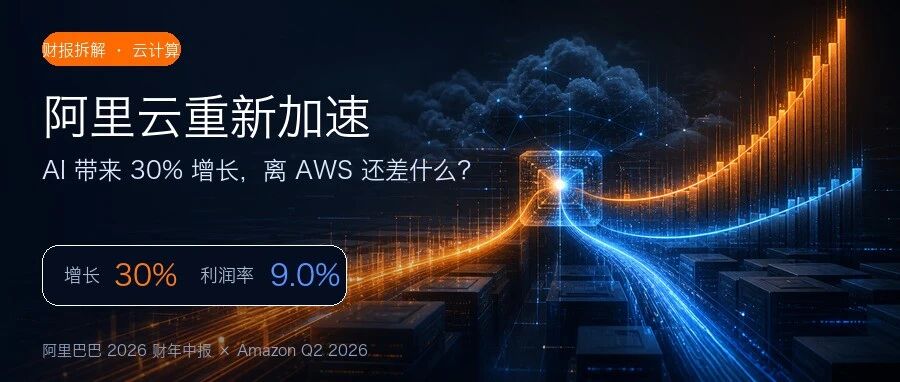
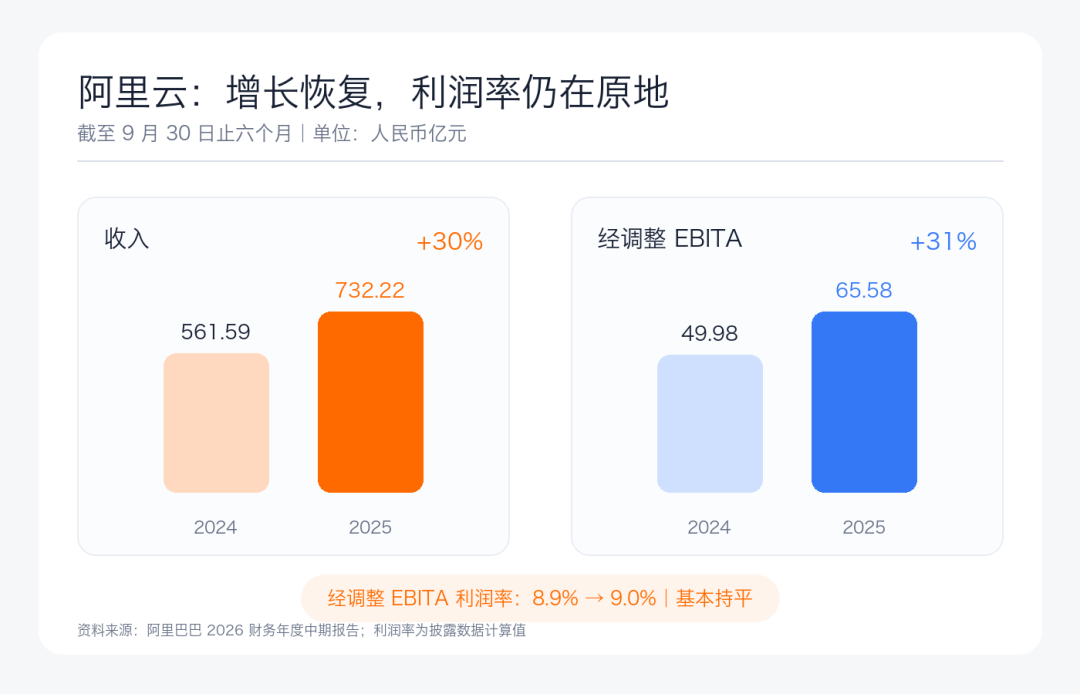
Alibaba Cloud is growing again. In the first half of fiscal year 2026, the cloud division reported a 30% year-over-year revenue increase, reaching RMB 73.2 billion. The adjusted EBITA also climbed 31% to RMB 6.6 billion. These numbers confirm that AI-related demand is no longer just a future promise—it's now a tangible driver of revenue. But a closer look reveals persistent challenges: profit margins remain thin compared to global leaders, and the group's free cash flow has turned sharply negative due to heavy infrastructure spending. The question isn't just whether Alibaba Cloud can sustain this growth, but whether it can translate it into durable profitability and financial strength.
Key Takeaways
-
AI fuels growth: Excluding intercompany revenue, cloud revenue grew 28% year-over-year, driven by public cloud and AI product adoption. This signals that external customers, not just Alibaba's own ecosystem, are fueling the expansion.
-
Profitability holds steady: Adjusted EBITA margin remained roughly flat at 9.0% (up from 8.9% a year earlier). While profit growth matched revenue growth, there's no sign yet of significant margin expansion—a critical metric for long-term sustainability.
-
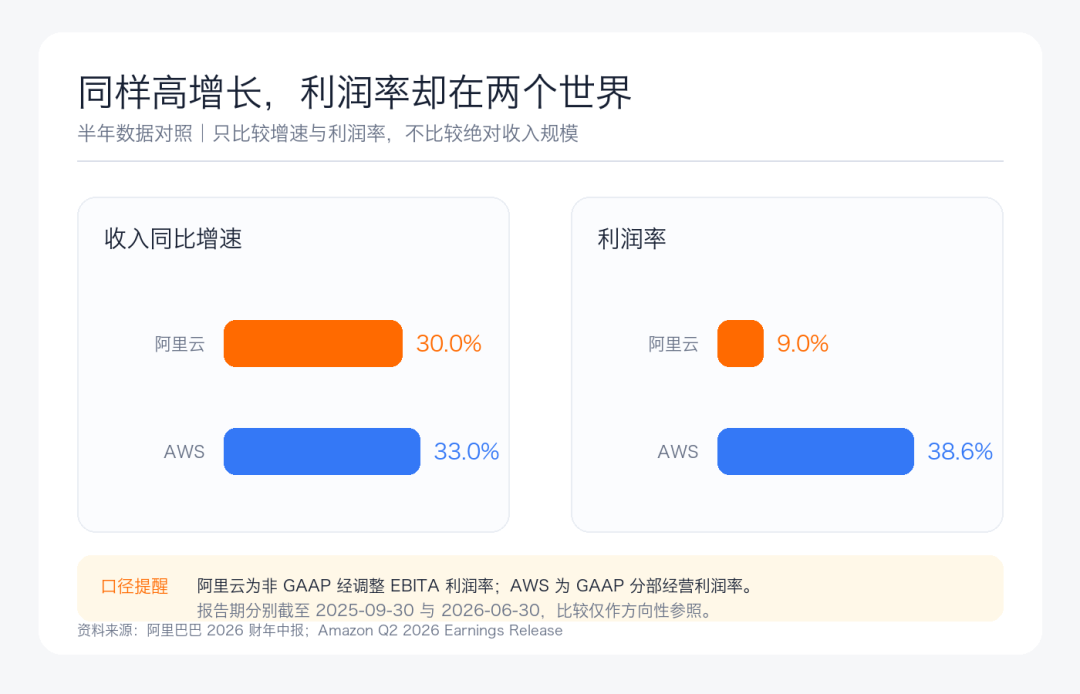
AWS comparison is stark: AWS posted a 33% revenue increase to $79.8 billion in H1 2026, with an operating margin of about 38.6%. Even accounting for different accounting standards and business mixes, the gap between 9% and 39% is enormous.
-
Infrastructure costs weigh: Depreciation, impairment, and land-use right costs for Alibaba Cloud totaled RMB 11.9 billion, about 16.2% of cloud revenue. This highlights the capital-intensive nature of the business and the need for high utilization.
-
Capital expenditure surge: Alibaba's capex more than doubled to RMB 70.2 billion in H1 FY2026, driven by cloud and AI infrastructure. This led to a free cash flow of negative RMB 40.7 billion, a sharp reversal from positive RMB 31.1 billion a year earlier.
-
Capital allocation concerns: While cloud and AI investments are necessary, Alibaba is also pouring money into instant retail (e.g., Taobao Flash Purchase), which dragged down China e-commerce adjusted EBITA by 47%. This dual-front spending raises questions about opportunity cost.
-
Product mix matters: Alibaba Cloud's future depends not just on selling raw compute, but on higher-margin software services like Qwen (its AI model), databases, data platforms, and agent development tools. The current report doesn't break out revenue from these segments.
Deep Dive: The Road to AWS-Like Margins
The 30% growth is a welcome turnaround, but it's only the entry ticket. To truly transform, Alibaba Cloud must address three structural layers that keep its margins far below AWS.
First, infrastructure efficiency. Cloud is a heavy-asset business, and Alibaba's depreciation costs are substantial. The 16.2% ratio of depreciation to revenue isn't proof of low utilization, but it underscores that every server must be maximized. AWS benefits from massive scale—its revenue is about seven times Alibaba's—allowing it to spread fixed costs over a much larger base. Alibaba's smaller scale in China, a market with different pricing dynamics, makes it harder to achieve similar efficiency.
Second, customer and delivery model. AWS sells highly standardized services globally, while Alibaba Cloud still relies more on customized solutions and heavy implementation. This slows down the realization of economies of scale. The more standardized the product, the easier it is to replicate and scale profitably.
Third, product mix. Basic compute is a commodity, subject to price wars. The real differentiators are software layers: AI models, databases, data platforms, and developer tools. Alibaba's Qwen model and its ecosystem are promising, but the company hasn't disclosed how much revenue these generate. If Alibaba can shift customer spending toward these high-margin services, margins could improve. However, this will require sustained R&D and ecosystem development.
Beyond margins, the most pressing issue is capital allocation. Alibaba's free cash flow turned negative for the first time in recent memory, largely due to cloud infrastructure and instant retail investments. While AI infrastructure is a strategic necessity, the instant retail bet is more debatable. It's a capital-intensive, low-margin business that may not generate the same long-term returns as AI. The company must carefully weigh whether these investments will create sustainable value or simply burn cash.
Looking ahead, Alibaba Cloud's "second takeoff" depends on its ability to convert this growth into profitable expansion. The 30% revenue growth is encouraging, but without margin improvement and positive free cash flow, it's just a number. The company needs to focus on high-value products, improve operational efficiency, and make disciplined capital allocation decisions.
Frequently Asked Questions
Why is Alibaba Cloud's profit margin so much lower than AWS's?
Several factors contribute: Alibaba Cloud's smaller scale (about 1/7 of AWS's revenue) limits economies of scale. The Chinese market has different pricing dynamics and a higher share of customized projects. Additionally, Alibaba's infrastructure is newer and still ramping up utilization, while AWS has had years to optimize its operations.
Will Alibaba Cloud's heavy investment in AI infrastructure pay off?
It's a long-term bet. The AI market is growing rapidly, and Alibaba is positioning itself to capture demand for compute and AI services. However, the payoff depends on whether these investments lead to high-margin software sales and sustained customer adoption, not just raw compute. The negative free cash flow is a risk, but if AI demand continues to grow, it could result in significant returns.
Is Alibaba Cloud a good investment right now?
This article is for informational purposes only. While the growth is promising, investors should consider the company's overall financial health, including negative free cash flow and competitive pressures. It's essential to monitor quarterly reports and industry trends before making any investment decisions.
Source: https://mp.weixin.qq.com/s/LS7xUn6-6xQ2DKWcR_yA8w
Related posts
Volkswagen to Cut 100,000 Jobs: Inside the Biggest Automaker Restructuring
Volkswagen plans 100,000 job cuts, four German plant closures, and a halved model lineup by 2035 as profits collapse and China earnings shrink.

Alibaba Scrapped Its P-Level System: What It Means for Your Company
Alibaba dismantled its 19-year-old P-level hierarchy in 2023. Here's why high-level 'performers' drain profits, and how smaller firms can cut layers before it's too late.
China's 2026 Unicorn Rankings: AI Reshapes the Top 10
China ranks second globally with 381 unicorns. AI leads the 2026 list as ByteDance, Ant Group, and DeepSeek dominate. Explore the shifting landscape.

ByteDance Boosts AI Talent Incentives with Doubao Stock Hike
ByteDance raises Doubao stock price by 14.6% to retain AI talent, expands equity incentives, and integrates teams to accelerate AI adoption in the workplace.
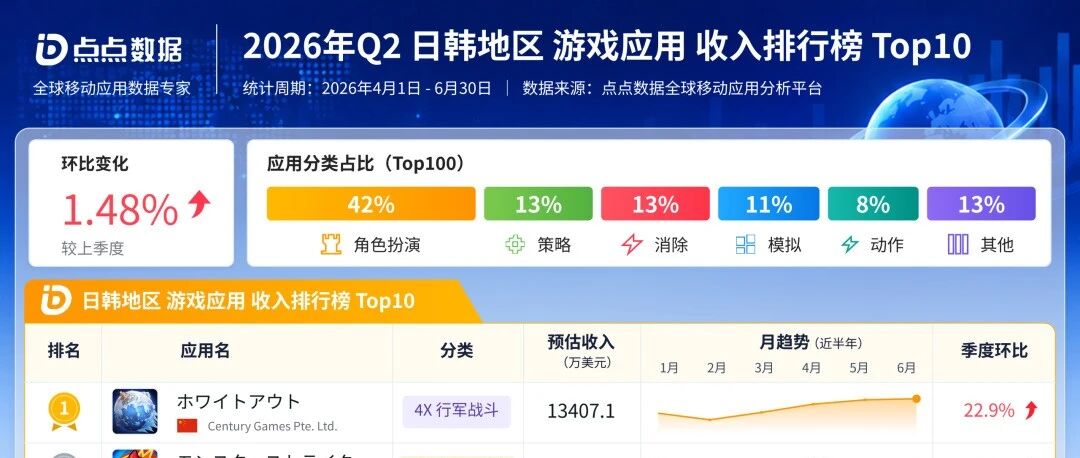
Chinese Mobile Games Dominate Japan & Korea Q2 2026 Revenue Charts
Diandian Interactive's Whiteout Survival and Kingshot top Japan/Korea Q2 2026 revenue rankings. Market shows steady growth with iOS users spending 1.2x more. Full analysis inside.

Global Mobile Gaming Revenue Dips 1% in August: Why Mid-Tier Games Are Losing
Sensor Tower's August report reveals a $66M monthly revenue drop in mobile gaming. Top titles grow while mid-tier suffers. Insights on market shifts, regional trends, and what it means for developers.
China Southern Airlines Incheon Airport Ground Staff Recruitment 2026: A Gateway for Bilingual Talent
China Southern Airlines is hiring ground staff at Incheon International Airport for 2026. Learn about the role, requirements, and why this is a strategic opportunity for Korean-Chinese bilinguals.

Korea Coast Guard 2026 Chinese Translation Exam: Key Dates & Rules
Korea Coast Guard's 2026 3rd recruitment Chinese translation written exam set for Sept 5. Learn schedule, scoring, ID rules, prohibited items, and results date.
Latest Articles
- Ukraine Expresses Betrayal Over US-Russia Diesel Deal
- WFP Chief Warns: 'Slow-Burning' Food Crisis as War, Climate, and Supply Chain Disruptions Collide
- Colin Mackerras: Australia's Renowned Sinologist and Bridge Between Nations
- UN Chief Condemns US Sanctions on International Criminal Court
- EU Parliament Report on China: Diplomatic Response & Future Outlook
- South Korea Successfully Tests First Indigenous Hypersonic Glide Vehicle