NetEase's H1 Gross Profit Hits ¥42.4B: Gaming Cash Cow Faces New Challenges
NetEase's H1 2026 gross profit reached ¥42.4B despite Q2 net profit dip due to investment losses. Gaming remains strong, but new titles lag. Analysis of financials, growth prospects, and shareholder returns.
Source: 陈璐瑶
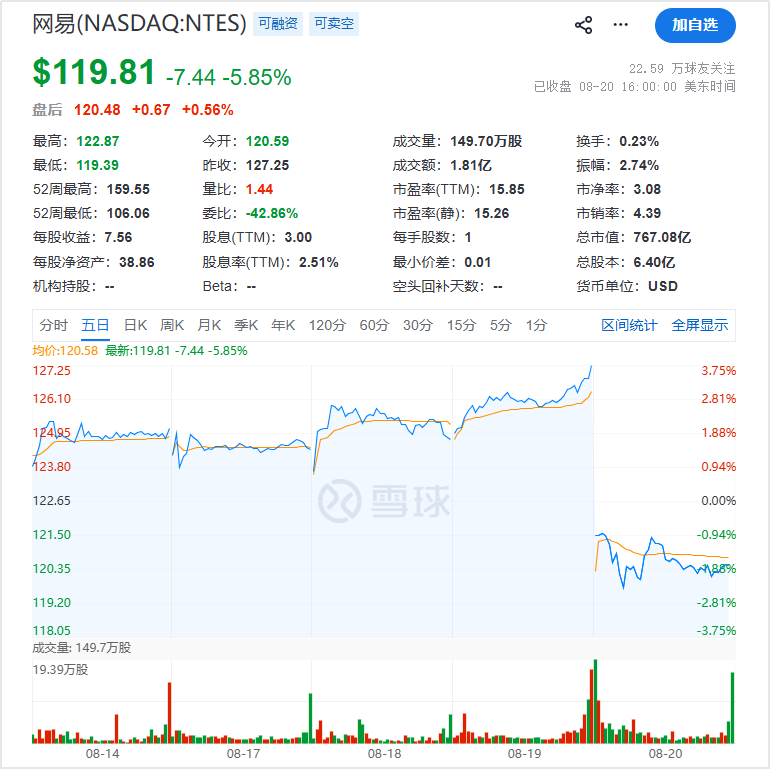
When NetEase released its Q2 2026 earnings on August 20, the headline numbers told two different stories. On one hand, net revenue climbed 7.9% year-over-year to ¥30.1 billion, beating market expectations. On the other, net profit attributable to shareholders tumbled 18.6% to ¥7 billion, dragged down by investment losses and currency exchange losses. Yet beneath this apparent contradiction lies a company that remains exceptionally profitable—its gross profit for the first half of the year hit a staggering ¥42.4 billion, underscoring the immense cash-generating power of its gaming business. Investors, however, seemed unimpressed, sending US-listed shares down 5.85% to $119.81 by close. Why the disconnect, and what does the future hold for one of China's oldest internet giants?
Key Takeaways
-
Q2 revenue growth beats estimates, but net profit falls due to one-time losses. NetEase's Q2 revenue rose 7.9% year-over-year to ¥30.1 billion, surpassing analyst expectations. However, net profit attributable to shareholders dropped 18.6% year-over-year and 34.6% quarter-over-quarter, primarily due to investment losses of approximately ¥2.95 billion and foreign exchange losses of ¥440 million. These losses were largely tied to declines in the stock prices of Pinduoduo and Alibaba, both of which fell over 20% in Q2.
-
Gross profit for H1 2026 reached ¥42.4 billion, up 16.2% year-over-year. Excluding the one-time investment and FX losses, NetEase's core operations remain highly profitable. Q2 gross profit alone was ¥21.22 billion, up 17.5% year-over-year and above the market consensus of ¥19.75 billion. This highlights the strength of its gaming and value-added services, which generate massive margins.
-
NetEase boasts a pristine balance sheet with zero interest-bearing debt. As of Q2, the company had no interest-bearing debt and a net cash balance of ¥167.5 billion. Industry insiders describe NetEase as having the 'cleanest' balance sheet among Chinese ADRs, though they note that Tencent and Alibaba have larger and more diversified asset bases. NetEase's advantage lies in its stability, disciplined spending, and reliable dividends.
-
Gaming remains the core revenue driver, but new titles are lacking. Gaming and related value-added services generated ¥25 billion in Q2, up nearly 10% year-over-year and accounting for 83% of total revenue. However, revenue still relies heavily on mature titles like Fantasy Westward Journey, Identity V, and Egg Party. The much-anticipated new game Forgotten Seas underperformed expectations after its July launch, with first-year revenue projections slashed from ¥3 billion to ¥1-2 billion.
-
Management acknowledges innovation hurdles but remains confident in long-term operations. In the earnings call, NetEase admitted that the 'roguelike open-world' gameplay and unique visual style of Forgotten Seas raised the barrier for player understanding, affecting early experience. Still, they emphasized that the team has a wealth of quality content in store and is actively preparing for global release, expressing strong confidence in long-term operation.
-
Upcoming pipeline includes Infinite and 3A title Return to Tang. Infinite, an urban open-world RPG, has surpassed 17 million global pre-registrations, with Bank of America projecting annual revenue of ¥10 billion. The game is expected to launch between late 2026 and early 2027. Additionally, NetEase's first 3A game Return to Tang and new titles like Ghostly Shadows and Under the Mist are in development.
-
Shareholder returns remain robust through dividends and buybacks. In 2025, NetEase paid out approximately ¥13.4 billion in four dividend rounds. Its $5 billion share repurchase program has been extended to January 9, 2029, with about 22.1 million ADSs repurchased for $2 billion by end-2025. This dual approach makes NetEase one of the most shareholder-friendly Chinese ADRs.

Deep Dive
NetEase's financials reveal a company at a crossroads. The H1 gross profit of ¥42.4 billion is a testament to the enduring profitability of its gaming segment, which enjoys high margins and a loyal user base. However, the market's negative reaction to Q2 earnings signals growing concerns about the company's growth trajectory. The lack of a blockbuster new title in the near term is a significant overhang. While Forgotten Seas was expected to fill that gap, its underperformance highlights the challenges of innovating in a mature market. The niche naval warfare genre, combined with NetEase's experimental 'roguelike' mechanics, may have limited its appeal. This is a reminder that even established players face risks when venturing into uncharted territory.
Looking ahead, NetEase's pipeline offers promise but not immediate relief. Infinite is a potential game-changer, given its massive pre-registration numbers and the growing popularity of open-world RPGs. However, its launch is still a year away, leaving a gap in the company's release schedule. In the meantime, NetEase will rely on its evergreen titles and the mobile version of Fantasy Westward Journey to sustain revenue. The latter, while not a new IP, could still generate incremental revenue by tapping into the existing fan base.
From a strategic perspective, NetEase's disciplined approach under CEO Ding Lei—divesting non-core assets, avoiding reckless M&A, and maintaining a fortress balance sheet—positions it well for long-term stability. The company's focus on shareholder returns through dividends and buybacks is commendable and provides a floor for the stock price. However, as long as the market perceives a lack of growth catalysts, the stock may remain range-bound. The upcoming gamescom presentation for Infinite could be a near-term catalyst, but investors will need patience.
In the broader context, NetEase operates in a competitive landscape where Tencent dominates with a vast ecosystem and AI investments. NetEase's advantage lies in its gaming expertise and financial prudence. As the industry shifts toward AI-driven content and global expansion, NetEase's ability to innovate while controlling costs will be key. The company's gross margin expansion, driven by favorable channel mix and lower iOS/Android fees, suggests structural improvements that could support profitability in the long run.

Frequently Asked Questions
Why did NetEase's net profit fall despite strong revenue growth? The decline was primarily due to non-operating items: investment losses of ¥2.95 billion (mainly from stakes in Pinduoduo and Alibaba) and foreign exchange losses of ¥440 million. These are one-time, non-cash charges that may reverse if the underlying stock prices recover. Excluding these, operating performance was solid.
What are NetEase's key growth drivers for the second half of 2026? In the near term, NetEase will rely on its established games like Fantasy Westward Journey and Egg Party. The next major product cycle is expected to begin around Q4 2026, with Infinite slated for a late 2026/early 2027 launch. The company is also working on several other titles, including a 3A game, which could contribute in 2027.
How does NetEase's balance sheet compare to Tencent and Alibaba? NetEase has the 'cleanest' balance sheet among Chinese ADRs, with zero debt and ¥167.5 billion in net cash. Tencent and Alibaba have larger and more diversified asset bases, but also higher leverage. NetEase's conservative approach ensures stability and consistent shareholder returns, while Tencent and Alibaba offer broader ecosystem exposure and potential for higher long-term growth.
Source: https://mp.weixin.qq.com/s/ukiCV9OkLeNv4hnR9gkQoQ
Related posts

Volkswagen to Cut 100,000 Jobs: Inside the Biggest Automaker Restructuring
Volkswagen plans 100,000 job cuts, four German plant closures, and a halved model lineup by 2035 as profits collapse and China earnings shrink.

Alibaba Scrapped Its P-Level System: What It Means for Your Company
Alibaba dismantled its 19-year-old P-level hierarchy in 2023. Here's why high-level 'performers' drain profits, and how smaller firms can cut layers before it's too late.
China's 2026 Unicorn Rankings: AI Reshapes the Top 10
China ranks second globally with 381 unicorns. AI leads the 2026 list as ByteDance, Ant Group, and DeepSeek dominate. Explore the shifting landscape.

ByteDance Boosts AI Talent Incentives with Doubao Stock Hike
ByteDance raises Doubao stock price by 14.6% to retain AI talent, expands equity incentives, and integrates teams to accelerate AI adoption in the workplace.
Chinese Mobile Games Dominate Japan & Korea Q2 2026 Revenue Charts
Diandian Interactive's Whiteout Survival and Kingshot top Japan/Korea Q2 2026 revenue rankings. Market shows steady growth with iOS users spending 1.2x more. Full analysis inside.

Global Mobile Gaming Revenue Dips 1% in August: Why Mid-Tier Games Are Losing
Sensor Tower's August report reveals a $66M monthly revenue drop in mobile gaming. Top titles grow while mid-tier suffers. Insights on market shifts, regional trends, and what it means for developers.

China Southern Airlines Incheon Airport Ground Staff Recruitment 2026: A Gateway for Bilingual Talent
China Southern Airlines is hiring ground staff at Incheon International Airport for 2026. Learn about the role, requirements, and why this is a strategic opportunity for Korean-Chinese bilinguals.

Korea Coast Guard 2026 Chinese Translation Exam: Key Dates & Rules
Korea Coast Guard's 2026 3rd recruitment Chinese translation written exam set for Sept 5. Learn schedule, scoring, ID rules, prohibited items, and results date.
Latest Articles
- South Korea to Tighten Military Exemption Rules for Athletes
- South Korea's Former President Yoon Suk Yeol Acquitted in Political Funding Case
- Paramount Skydance Merger: A Historic Media Consolidation
- British Airways Expands Business Class to 106 Seats on A380: The Future of Luxury Travel
- Cheapest & Most Expensive US Flights in November 2026
- Key States Hold Clues to 2026 Midterm Election Outcomes