AI Ad Creatives Quadrupled but Revenue Dropped 75%: Top Heroes Case Study
Top Heroes saw AI-generated ad creatives quadruple while daily revenue fell 75%. Learn why volume doesn't equal performance and how to build effective AI ad strategies.
Source: 葱游柄
The mobile gaming industry is in a strange paradox. AI tools have made it easier than ever to produce ad creatives at scale, yet a high-profile case study shows that more content can actually lead to less revenue. The game Top Heroes reportedly quadrupled its AI-generated ad output, only to see daily revenue plummet from around $1 million to $250,000—a 75% drop. This stark example has sent shockwaves through the user acquisition community, forcing marketers to question whether they are optimizing for the right metrics.
In this article, we break down the key trends in AI-powered ad creatives, analyze why more volume didn't translate into better results, and offer practical advice on how to leverage AI without falling into the same trap.
Key Takeaways from the Top Heroes Case
-
AI dramatically increases creative volume, but not necessarily quality. Teams can now produce 20 creatives a day instead of 5, but if those extra 15 don't perform better, they just add noise to the system.
-
The "no ads" and "no VIP" messaging has become universal across genres. From 4X strategy to puzzle games, advertisers are leaning into the promise of a friction-free experience, but this can backfire if the actual game doesn't deliver on that promise.
-
Repetitive story templates dominate. One viral template shows a fat character being humiliated and then seeking revenge. It's recycled across dozens of games with only superficial changes. AI makes it easy to swap characters and settings, but the underlying narrative is stale.
-
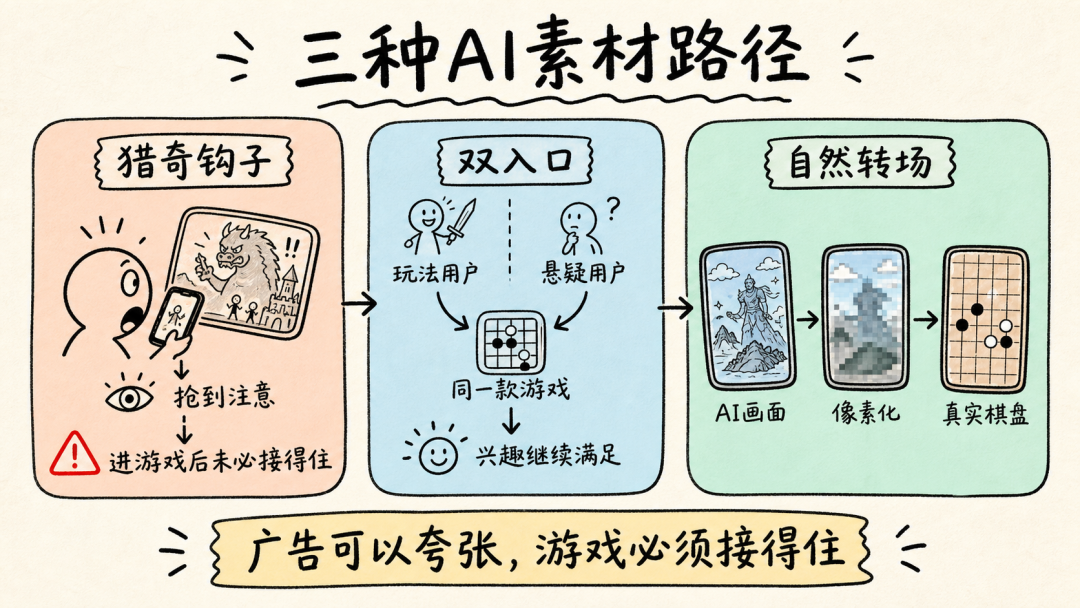
AI's short-term value lies in scaling variants, not inventing new concepts. Instead of creating fresh ideas, AI is being used to generate dozens of variations of proven hooks, which can lead to creative fatigue among audiences.
-
The disconnect between ad promise and actual gameplay is a major issue. Many AI-generated ads are so absurd that players have no idea what the game actually is. This leads to high click-through rates but poor retention and monetization.
-
Top Heroes' revenue collapse illustrates the danger of prioritizing quantity over quality. The game's daily revenue fell by 75% despite a fourfold increase in ad output, showing that volume alone doesn't drive success.
-
Successful AI ads seamlessly transition from the hook to real gameplay. Games like Pixel Flow and Meow Doku use AI to create an engaging opening that naturally morphs into the actual game board, ensuring players know what to expect.

Deep Dive: Why More Creatives Didn't Save Top Heroes
The Top Heroes case is a cautionary tale for any team that believes AI is a silver bullet for user acquisition. The core issue is not that AI is ineffective—it's that the way it's being used is fundamentally flawed. When you can generate hundreds of ad variations in a day, the temptation is to test everything and let the algorithm sort it out. But this approach ignores a critical principle: you need to learn from each test to improve your strategy over time.
In the traditional creative testing model, a team might create 10 to 20 handcrafted ads, run them, analyze the results, and then iterate based on what worked. AI breaks this cycle by enabling a "spray and pray" approach, where teams launch dozens of variations simultaneously. The problem is that when you change multiple variables at once—character, setting, script, voiceover—you can't isolate which change drove the performance. Even if one version outperforms, you don't know why, so you can't replicate that success in the next round.
Moreover, AI-generated ads often suffer from a lack of coherence. They might have a compelling hook in the first three seconds, but then the rest of the ad falls apart, or it doesn't connect to the actual gameplay. This creates a disconnect that leads to high install rates but terrible retention. Players download the game expecting the wild experience from the ad, only to find a completely different game. They churn quickly, and the ad spend is wasted.
The industry is also facing a broader challenge: the global time spent on casual games has declined by 28% over the past five years. This means the pie is shrinking, and the cost of acquiring users is rising. In such an environment, relying on AI to churn out low-quality ads is not a sustainable strategy. Instead, teams need to focus on creating ads that accurately represent the game and resonate with the target audience.
Looking ahead, the winners will be those who use AI as a tool to enhance creativity, not replace it. They will combine AI's speed with human insight to test hypotheses, learn from data, and refine their approach. The key is to treat AI as a force multiplier for a well-defined creative strategy, not as a substitute for it.

Frequently Asked Questions
Q: Does AI-generated ad creative always lead to worse performance?
A: No, not always. AI can be highly effective when used correctly. The problem is that many teams use AI to generate massive volumes of low-quality ads without a clear testing framework. When AI is used to create variations of a proven concept and is integrated with proper tracking and analysis, it can improve efficiency and results.
Q: How can I avoid the Top Heroes trap in my own campaigns?
A: Focus on quality over quantity. Start with a clear hypothesis about what will resonate with your target audience. Use AI to generate a few variations of a single variable, test them, and analyze the results. Ensure that your ads accurately represent the gameplay experience to avoid high churn. Finally, track not just clicks and installs, but also retention and ROAS to get a full picture.
Q: What are the best practices for using AI in ad creative production?
A: Best practices include: 1) Test one variable at a time to learn what works. 2) Align your ad's promise with the actual game experience. 3) Use AI to create hooks that naturally transition into gameplay. 4) Combine front-end metrics (clicks, installs) with back-end metrics (retention, revenue) to evaluate true performance. 5) Document your learnings and build a repository of reusable insights.

Source: https://mp.weixin.qq.com/s/S1kntF-bCk3IivLO85cz8g
Related posts

Volkswagen to Cut 100,000 Jobs: Inside the Biggest Automaker Restructuring
Volkswagen plans 100,000 job cuts, four German plant closures, and a halved model lineup by 2035 as profits collapse and China earnings shrink.

Alibaba Scrapped Its P-Level System: What It Means for Your Company
Alibaba dismantled its 19-year-old P-level hierarchy in 2023. Here's why high-level 'performers' drain profits, and how smaller firms can cut layers before it's too late.
China's 2026 Unicorn Rankings: AI Reshapes the Top 10
China ranks second globally with 381 unicorns. AI leads the 2026 list as ByteDance, Ant Group, and DeepSeek dominate. Explore the shifting landscape.

ByteDance Boosts AI Talent Incentives with Doubao Stock Hike
ByteDance raises Doubao stock price by 14.6% to retain AI talent, expands equity incentives, and integrates teams to accelerate AI adoption in the workplace.
Chinese Mobile Games Dominate Japan & Korea Q2 2026 Revenue Charts
Diandian Interactive's Whiteout Survival and Kingshot top Japan/Korea Q2 2026 revenue rankings. Market shows steady growth with iOS users spending 1.2x more. Full analysis inside.

Global Mobile Gaming Revenue Dips 1% in August: Why Mid-Tier Games Are Losing
Sensor Tower's August report reveals a $66M monthly revenue drop in mobile gaming. Top titles grow while mid-tier suffers. Insights on market shifts, regional trends, and what it means for developers.

China Southern Airlines Incheon Airport Ground Staff Recruitment 2026: A Gateway for Bilingual Talent
China Southern Airlines is hiring ground staff at Incheon International Airport for 2026. Learn about the role, requirements, and why this is a strategic opportunity for Korean-Chinese bilinguals.
Korea Coast Guard 2026 Chinese Translation Exam: Key Dates & Rules
Korea Coast Guard's 2026 3rd recruitment Chinese translation written exam set for Sept 5. Learn schedule, scoring, ID rules, prohibited items, and results date.
Latest Articles
- Hurricane Isaias Prepares To Hit Gulf Coast: Oil Industry Evacuates, Refineries At Risk
- South Korea Successfully Tests First Indigenous Hypersonic Glide Vehicle
- Delta Air Lines Cuts 2026 Forecast Due to Fuel Surge, Despite Strong Demand
- Botswana President's State Visit to China: Strengthening Strategic Partnership
- US Budget Deficit Reaches $2 Trillion in FY 2026: A Warning Sign for Global Markets
- EU Parliament Report on China: Diplomatic Response & Future Outlook