Optical Module Giants See $426M Market Cap Wiped Out Despite Record Profits
China's top optical module makers reported stellar H1 2026 earnings, but a $426M market cap drop and weak cash flow raise concerns about inventory buildup and sustainability.
Source: 21记者
On August 25, 2026, shares of China's leading optical module makers—Zhongji Innolight, Eoptolink, and TFC Communication—continued to slide, erasing nearly 42.6 billion yuan (approx. $6 billion) in combined market value. This came just a day after their latest earnings reports revealed record profits, with combined net income of 22.38 billion yuan for the first half of the year. The disconnect between strong earnings and falling stock prices highlights growing investor anxiety over cash flow quality, inventory levels, and the sustainability of the AI-driven demand boom.

Key Takeaways
-
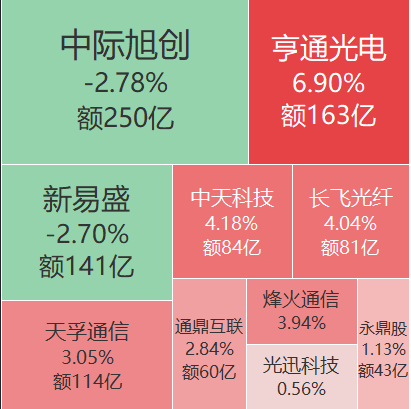
Market Cap Erosion: On August 25, Zhongji Innolight and Eoptolink each fell over 2.7%, while TFC Communication rose 3%. The combined trading volume for the three companies was 50.5 billion yuan, indicating heavy investor activity and uncertainty.
-
Overseas Revenue Dominance: Eoptolink derived 97.92% of its revenue from overseas markets (20.47 billion yuan), while Zhongji Innolight's overseas revenue surged 209.9% year-over-year to 39.6 billion yuan, accounting for 94.82% of its total. TFC Communication, an upstream component maker, saw 55.46% of its revenue from abroad.
-
Record Profits: The trio's combined net profit for H1 2026 reached 22.38 billion yuan. Zhongji Innolight led with 13.65 billion yuan, followed by Eoptolink at 7.53 billion yuan and TFC at 1.2 billion yuan. These figures reflect the explosive demand for high-speed optical modules from North American cloud giants.
-
Capital Expenditure Surge: Alphabet raised its 2026 capex guidance to $195-205 billion, Meta lifted its floor to $130 billion, and Amazon projected around $220 billion. These investments are accelerating the shift to 800G and 1.6T optical modules, with 1.6T silicon photonics entering mass production.
-
Cash Flow Mismatch: Despite record profits, operating cash flow for the three companies totaled only 4.42 billion yuan. Zhongji Innolight's operating cash flow dropped 44.08% to 1.8 billion yuan, while its net profit was 13.65 billion yuan. This gap is largely due to aggressive inventory stocking and prepayments to secure scarce components.
-
Inventory and Receivables Swell: Combined inventories reached 32.41 billion yuan, and accounts receivable hit 24 billion yuan. Zhongji Innolight's inventory grew 56.34% to 19.83 billion yuan, and Eoptolink's prepayments skyrocketed 51-fold to 870 million yuan in just six months.
-
Component Shortages: High-speed EML optical chips remain in tight supply, with the supply-demand gap widening to over 30%. Some 200G EML orders have visibility extending to 2028, prompting module makers to lock in capacity through long-term agreements and prepayments.
-
Margin Expansion: Product mix upgrades boosted margins. Zhongji Innolight's optical module gross margin rose 6.63 percentage points to 46.59%, while Eoptolink's optical interconnect margin reached 48.46%. TFC's net margin was the highest at 42.59%.

In-Depth Analysis
The stark contrast between the stellar income statements and the weak cash flow statements tells a compelling story about the optical module industry's current phase. On one hand, the demand from North American cloud service providers (CSPs) is undeniably robust, driving quarterly revenue growth of 14-50% and pushing margins to historic highs. On the other hand, the massive build-up of inventory and receivables—amounting to over 56 billion yuan combined—raises questions about whether these assets will convert to cash as smoothly as expected.
Management from Zhongji Innolight attributes the cash flow drain to strategic stockpiling of raw materials and prepayments to secure critical components like EML chips and 3nm DSPs. They argue that customer payment terms haven't changed and that the high receivables balance at month-end reflects the lumpy nature of shipments. This explanation is plausible in a hyper-growth environment, but it also introduces execution risk. If demand softens or technology shifts faster than anticipated, these companies could be left with obsolete inventory and strained balance sheets.
The market's reaction—a $426 million market cap drop—suggests investors are starting to price in these risks. The optical module sector has been a darling of the AI trade, but as valuations climb, scrutiny over cash conversion and inventory turns intensifies. The fact that the combined operating cash flow is only 19.7% of net income is a red flag for value-oriented investors, even if growth investors remain optimistic.
Looking ahead, the industry's trajectory hinges on the 2027 capex guidance from cloud giants. If their spending continues to escalate, the current inventory hoarding will prove prescient. However, any sign of capex moderation could trigger a sharp correction. The companies themselves remain confident, citing order visibility into 2027 and beyond. Zhongji Innolight mentioned that many customers have already placed orders for 2027, with 1.6T and 800G demand still growing rapidly.
Another critical factor is the competitive landscape. While new entrants are emerging, CSPs are allocating the majority of 1.6T orders to incumbent suppliers, preserving the current market structure. This gives established players like Zhongji Innolight and Eoptolink a moat, but it also means they must continue to invest heavily in R&D and capacity expansion to maintain their positions. R&D spending increased significantly: Zhongji Innolight's R&D costs rose 110.62% to 1.23 billion yuan, and Eoptolink's rose 31.85% to 440 million yuan.
Technological evolution will also shape the future. The industry expects 3.2T solutions to mature by 2028, and silicon photonics is gaining traction in 800G products. Zhongji Innolight is already developing 2.4T, NPO, and XPO solutions, with mass production targeted for the second half of 2027. NPO (near-packaged optics) is seen as a promising approach for scale-up scenarios, offering easier maintenance and lower costs. The coexistence of pluggable, NPO, and CPO (co-packaged optics) suggests a diversified future, but also increases the risk of technology missteps.
In the short term, the stock price decline may present a buying opportunity for those who believe in the long-term bandwidth upgrade cycle. However, the gap between accounting profits and cash generation is a reminder that not all earnings are created equal. Investors should monitor quarterly cash flow statements closely and watch for any signs of inventory write-downs or receivables deterioration. The next catalyst will be the Q3 earnings reports and any updates to 2027 capex guidance from major cloud providers.
Frequently Asked Questions
Why did the stock prices drop despite strong earnings?
The market is concerned about the poor cash flow conversion and the massive buildup of inventory and receivables. Investors worry that these assets might not convert to cash if demand slows, leading to potential write-downs. The market cap erosion reflects these fears, even though the companies' order books remain robust.
How sustainable is the demand for optical modules?
Demand is currently driven by massive capital expenditures from North American cloud giants like Alphabet, Meta, and Amazon. These companies are investing heavily in AI infrastructure, which requires high-speed optical interconnects. While the near-term outlook is strong, sustainability depends on continued AI adoption and data center expansion. If cloud capex peaks or AI spending slows, the optical module market could face a cyclical downturn.
What are the main risks for investors in these companies?
The key risks include: (1) inventory obsolescence due to rapid technology shifts, (2) customer concentration in a few large CSPs, (3) supply chain constraints for critical components like EML chips and DSPs, and (4) potential price competition as new entrants emerge. Additionally, the companies' heavy reliance on overseas revenue exposes them to geopolitical and trade risks.

Source: https://mp.weixin.qq.com/s/W2BxwH7nURxACjnSC9-Zxw
Related posts

Volkswagen to Cut 100,000 Jobs: Inside the Biggest Automaker Restructuring
Volkswagen plans 100,000 job cuts, four German plant closures, and a halved model lineup by 2035 as profits collapse and China earnings shrink.

Alibaba Scrapped Its P-Level System: What It Means for Your Company
Alibaba dismantled its 19-year-old P-level hierarchy in 2023. Here's why high-level 'performers' drain profits, and how smaller firms can cut layers before it's too late.

China's 2026 Unicorn Rankings: AI Reshapes the Top 10
China ranks second globally with 381 unicorns. AI leads the 2026 list as ByteDance, Ant Group, and DeepSeek dominate. Explore the shifting landscape.

ByteDance Boosts AI Talent Incentives with Doubao Stock Hike
ByteDance raises Doubao stock price by 14.6% to retain AI talent, expands equity incentives, and integrates teams to accelerate AI adoption in the workplace.
Chinese Mobile Games Dominate Japan & Korea Q2 2026 Revenue Charts
Diandian Interactive's Whiteout Survival and Kingshot top Japan/Korea Q2 2026 revenue rankings. Market shows steady growth with iOS users spending 1.2x more. Full analysis inside.

Global Mobile Gaming Revenue Dips 1% in August: Why Mid-Tier Games Are Losing
Sensor Tower's August report reveals a $66M monthly revenue drop in mobile gaming. Top titles grow while mid-tier suffers. Insights on market shifts, regional trends, and what it means for developers.

China Southern Airlines Incheon Airport Ground Staff Recruitment 2026: A Gateway for Bilingual Talent
China Southern Airlines is hiring ground staff at Incheon International Airport for 2026. Learn about the role, requirements, and why this is a strategic opportunity for Korean-Chinese bilinguals.

Korea Coast Guard 2026 Chinese Translation Exam: Key Dates & Rules
Korea Coast Guard's 2026 3rd recruitment Chinese translation written exam set for Sept 5. Learn schedule, scoring, ID rules, prohibited items, and results date.
Latest Articles
- Botswana President's State Visit to China: Strengthening Strategic Partnership
- US Budget Deficit Reaches $2 Trillion in FY 2026: A Warning Sign for Global Markets
- South Korea Successfully Tests First Indigenous Hypersonic Glide Vehicle
- EU Parliament Report on China: Diplomatic Response & Future Outlook
- Starbucks Acquisition of Chipotle: A Strategic Fit or Financial Overreach?
- Japan Requests China Show 'Respect' to Prime Minister, Sparks Diplomatic Row