TikTok's $400M COPPA Fine: A Record-Breaking Lesson in Child Privacy
TikTok and ByteDance agree to pay $400 million to settle U.S. child privacy lawsuit—the largest COPPA penalty ever. Explore the implications for tech giants and the future of age verification.
Source: 草帽
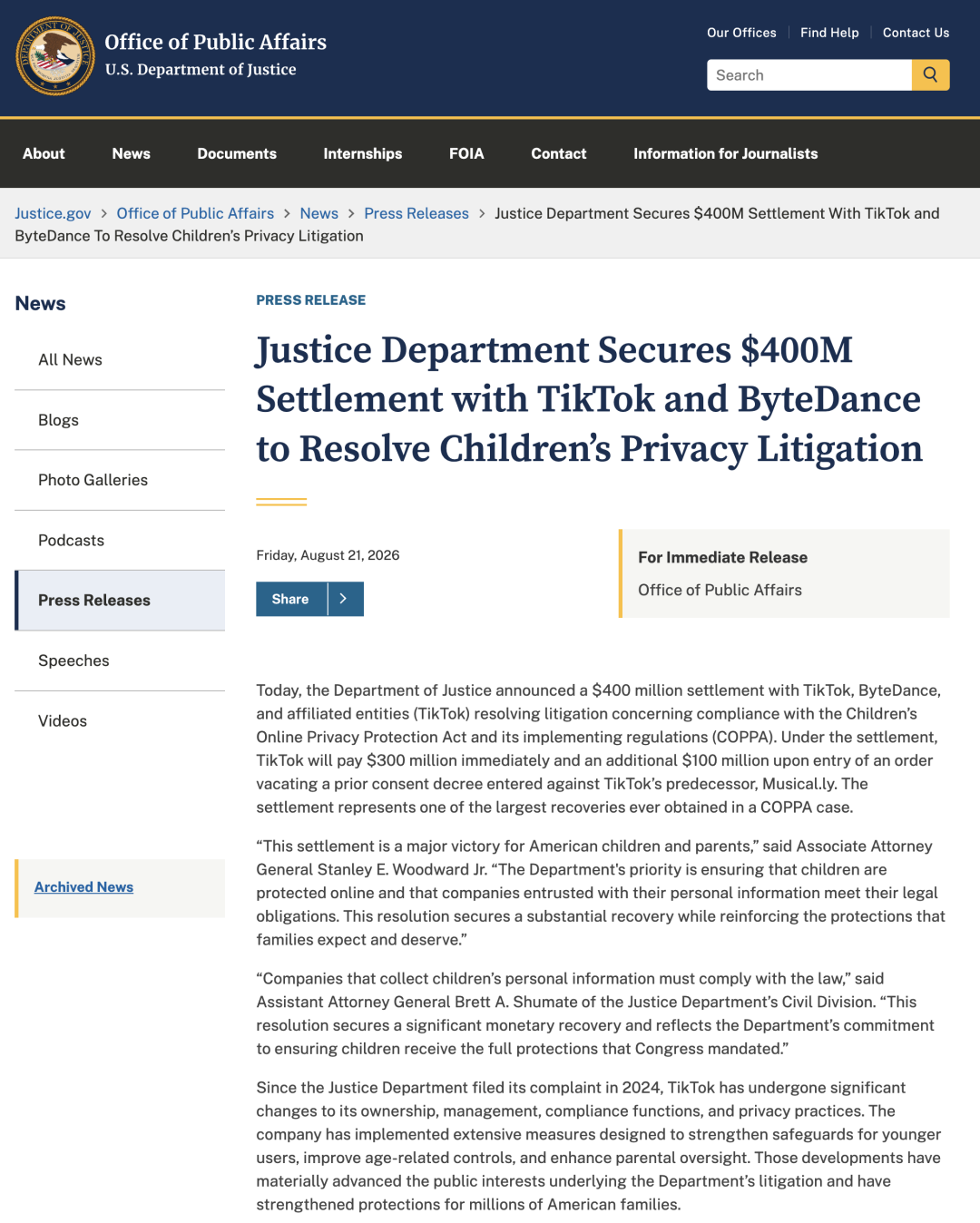
When TikTok finally cleared the 'sell-or-ban' hurdle in the United States, it immediately stumbled into another record-breaking setback. On August 21, 2026, the U.S. Department of Justice announced that TikTok, ByteDance, and related companies agreed to pay $400 million to resolve a lawsuit over child online privacy violations. This settlement, the largest ever under the Children's Online Privacy Protection Act (COPPA), marks a pivotal moment in tech regulation. But beyond the eye-watering fine, it signals a fundamental shift in how platforms handle data belonging to minors—and a stark warning for the entire industry.
Key Takeaways
- Historic Settlement Amount: TikTok will pay $300 million upfront, with an additional $100 million due after a court lifts the 2019 consent decree related to Musical.ly. The total $400 million is the largest COPPA penalty in U.S. history, dwarfing the previous record of $170 million paid by Google/YouTube in 2019.
- Root of the Lawsuit: The U.S. Department of Justice and the Federal Trade Commission accused TikTok of knowingly allowing users under 13 to register standard accounts, collecting personal data (names, emails, geolocation) without parental consent, and retaining that data improperly.
- Repeat Offender: This is not TikTok's first run-in with child privacy laws. In 2019, its predecessor Musical.ly paid a $5.7 million fine for similar violations. The new penalty is roughly 70 times larger, highlighting the escalating stakes.
- COPPA's Strict Threshold: Under COPPA, platforms must obtain verifiable parental consent before collecting data from children under 13. Recent FTC rule updates, effective fully by 2026, expand protections to biometric and government ID data, and require additional consent for sharing children's data with third parties for targeted advertising.
- Broader Industry Impact: TikTok joins a growing list of tech giants fined for child privacy breaches, including Google ($170M), Epic Games ($275M), Amazon ($25M), Microsoft Xbox ($20M), and Disney ($10M). This trend underscores a regulatory crackdown across the digital ecosystem.
- Product Logic Rethink: The fine is just the beginning. Companies must overhaul their product design to comply with age verification and data minimization, which often creates a paradox: to collect less data on kids, they must first collect more data to determine age.
- TikTok's U.S. Journey: From the 2020 sale-or-ban pressure to the 2026 data security joint venture, TikTok restructured its U.S. operations, with ByteDance reducing its stake to 19.9% and U.S. and international investors holding 80.1%. The settlement is seen as a 'historical account settlement' after this power shift.
Deep Dive Analysis
The $400 million fine is not merely a financial penalty; it represents a seismic shift in the regulatory landscape for digital platforms. First, it signals that U.S. regulators are willing to impose historic fines to enforce child privacy laws, setting a precedent that could embolden other jurisdictions (like the EU under GDPR) to take similar actions. Second, it exposes the inherent tension between user growth and compliance. TikTok's massive user base—over 200 million in the U.S.—makes age verification a daunting task, but the fine shows that ignorance is not an excuse.
Moreover, the settlement's structure—with the second $100 million tied to lifting the 2019 order—indicates a strategic legal maneuver to consolidate past liabilities. This could be a template for other companies facing multiple consent decrees. The real cost, however, lies in the operational changes TikTok must implement. The FTC's recent policy guidance offers some relief: if platforms collect data solely for age verification, use it only for that purpose, delete it promptly, and ensure security, they may avoid additional penalties. This creates a delicate balance—companies must collect more data (like selfies or IDs) to verify age, which ironically increases privacy risks.
Looking ahead, we can expect more platforms to adopt privacy-preserving age estimation technologies, such as AI-based facial analysis or federated learning, to comply without over-collecting. The TikTok case also highlights the growing trend of 'data localization' and ownership restructuring as a means to satisfy regulators. By handing over control to U.S. investors and storing data on Oracle's cloud, TikTok has aligned itself with national security expectations, which may have influenced the settlement's outcome. For the tech industry, this is a clear signal: child privacy is non-negotiable, and the cost of non-compliance is skyrocketing.
Frequently Asked Questions
Why is the fine so much larger than previous penalties? The increase reflects a combination of factors: TikTok's massive scale, the repeated nature of the violation, and a stricter regulatory environment. Regulators are sending a message that child privacy violations will be met with severe consequences, especially for platforms with millions of young users.
What does this mean for other social media platforms? It serves as a stark warning. Any platform that collects data from users under 13 without proper parental consent risks similar or even larger fines. Companies must proactively implement robust age verification and parental consent mechanisms, or face legal and financial repercussions.
How will TikTok change its practices after this settlement? TikTok will likely introduce more rigorous age verification at sign-up, possibly using AI-driven age estimation or requiring parental consent for users under 13. It will also need to enhance data deletion protocols and ensure that any data collected for age verification is handled minimally and securely.

Source: https://mp.weixin.qq.com/s/NlHHIAYEVuyRV5GPa_sGFA
Related posts

Volkswagen to Cut 100,000 Jobs: Inside the Biggest Automaker Restructuring
Volkswagen plans 100,000 job cuts, four German plant closures, and a halved model lineup by 2035 as profits collapse and China earnings shrink.

Alibaba Scrapped Its P-Level System: What It Means for Your Company
Alibaba dismantled its 19-year-old P-level hierarchy in 2023. Here's why high-level 'performers' drain profits, and how smaller firms can cut layers before it's too late.

China's 2026 Unicorn Rankings: AI Reshapes the Top 10
China ranks second globally with 381 unicorns. AI leads the 2026 list as ByteDance, Ant Group, and DeepSeek dominate. Explore the shifting landscape.

ByteDance Boosts AI Talent Incentives with Doubao Stock Hike
ByteDance raises Doubao stock price by 14.6% to retain AI talent, expands equity incentives, and integrates teams to accelerate AI adoption in the workplace.
Chinese Mobile Games Dominate Japan & Korea Q2 2026 Revenue Charts
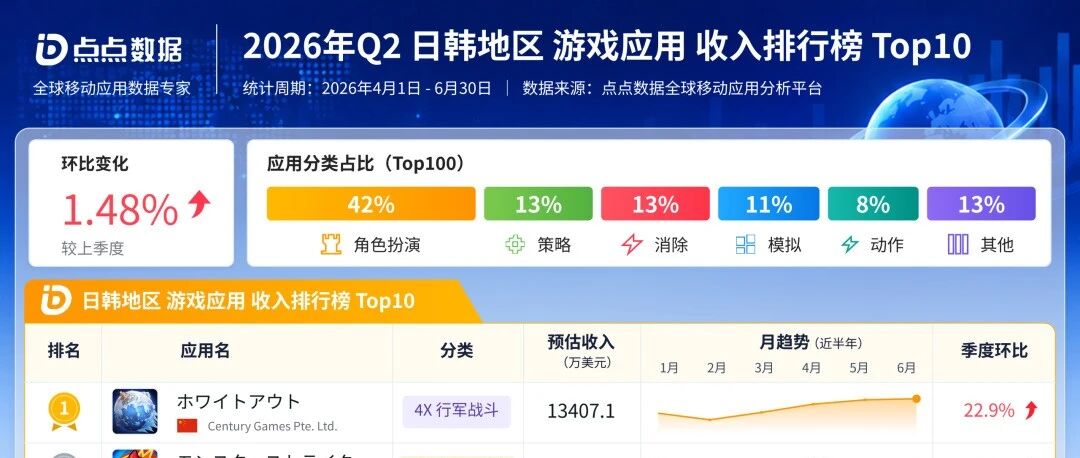
Diandian Interactive's Whiteout Survival and Kingshot top Japan/Korea Q2 2026 revenue rankings. Market shows steady growth with iOS users spending 1.2x more. Full analysis inside.

Global Mobile Gaming Revenue Dips 1% in August: Why Mid-Tier Games Are Losing
Sensor Tower's August report reveals a $66M monthly revenue drop in mobile gaming. Top titles grow while mid-tier suffers. Insights on market shifts, regional trends, and what it means for developers.

China Southern Airlines Incheon Airport Ground Staff Recruitment 2026: A Gateway for Bilingual Talent
China Southern Airlines is hiring ground staff at Incheon International Airport for 2026. Learn about the role, requirements, and why this is a strategic opportunity for Korean-Chinese bilinguals.

Korea Coast Guard 2026 Chinese Translation Exam: Key Dates & Rules
Korea Coast Guard's 2026 3rd recruitment Chinese translation written exam set for Sept 5. Learn schedule, scoring, ID rules, prohibited items, and results date.
Latest Articles
- PepsiCo Slashes Earnings Forecast as North American Turnaround Faces Delays
- Japan Requests China Show 'Respect' to Prime Minister, Sparks Diplomatic Row
- German Intelligence Chief Arrested in Major Espionage Scandal
- US Company Accuses Chinese Entities of AI Attacks on Korean Banks
- Israel Closes UK Consulate in Jerusalem, Escalating Diplomatic Tensions
- Death Penalty Failure in Tennessee: Legal and Ethical Crisis After Krista Parker Survives Execution