Why Staying 3 Years at a Big Tech Firm Beats the Average: Tenure Trends in 2026
Discover why 3 years at a major tech company outlasts most peers. Explore tenure trends at JD, Huawei, Tencent, and more, plus a self-check list for career decisions.
In the fast-paced world of tech, job-hopping is often seen as the norm. But recent data reveals a surprising truth: staying at one company for just three years puts you ahead of the majority of your peers. With the average tenure in China's internet industry hovering around 2.55 years, long-term employment is becoming a rare and valuable commodity. This article dives into the tenure trends at top tech firms, the strategies they use to retain talent, and what this means for your career.
Key Takeaways
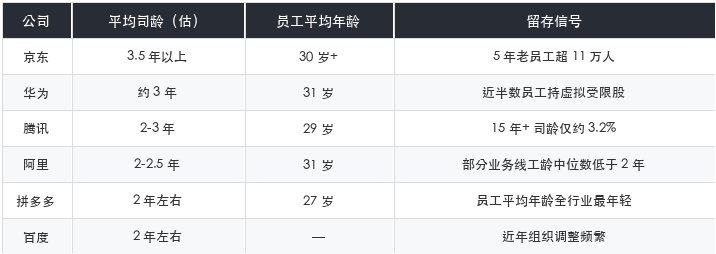
- Average Tenure Is Shockingly Low: Across China's internet industry, the average employee stays at a company for only 2.55 years. This means that hitting the three-year mark already places you above the median, making you part of a select group that has weathered the initial storm of adaptation and performance pressure.
- JD.com Leads in Retention: JD.com stands out with over 110,000 employees who have been with the company for five years or more. Their secret? A vast operational network spanning logistics, warehousing, and customer service, offering diverse career paths and internal mobility. This, combined with the practical anchors of housing, family, and children's schooling, makes leaving a high-cost decision.
- Huawei and Tencent Use 'Certainty' to Retain: Huawei's virtual restricted stock and a unique retirement policy at age 45 (with continued dividends) create a powerful incentive for long-term commitment. Tencent offers a generous 'honorary retirement' package after 15 years of service, but only 3.2% of employees actually reach that milestone. These policies serve as psychological anchors, signaling that the company values loyalty, even if few can fully realize the benefits.
- Short Tenures Signal Structural Issues: Companies like Alibaba (in some divisions) and Pinduoduo have median tenures under two years. This is often due to intense performance pressure, limited promotion slots, and salary inversion (new hires earning more than veterans). These factors create a self-selecting environment where only the most adaptable or ambitious stay, while others move on.
- Short Tenure Isn't Always Bad: High turnover can mean faster promotions and salary growth for those who stay. Frequent job changes might yield 30% salary bumps each time, potentially outpacing the cumulative gains of staying put. However, this comes at the cost of losing unvested stock, building a new reputation, and starting from scratch on relationships.
- Long Tenure Has Its Own Risks: In stable companies like JD.com, the sheer number of long-tenured employees means management positions are often occupied, leaving fewer opportunities for newcomers to advance. Young employees may find themselves 'waiting in line' for years, which can be frustrating for ambitious individuals.
- A Self-Check List for Career Decisions: Before choosing a company, ask yourself: Will the extra money from job-hopping compensate for lost stock and seniority? Are you becoming more valuable or more vulnerable with age? Is your role scarce or replaceable? Does the company retain you with money, position, or certainty? These questions help clarify what you truly value in your career.
In-Depth Analysis
The tenure trends at major tech companies reveal a deeper strategic shift in how corporations manage talent. JD.com's emphasis on retention is not just about employee satisfaction; it's a calculated move to maintain operational stability in a labor-intensive sector. The company's physical infrastructure—warehouses, delivery networks—requires a workforce that understands the intricacies of logistics, and retaining experienced employees reduces training costs and errors. This is why JD.com has invested in 'baby chairs' in cafeterias and 'old employee days'—they are building an ecosystem where staying is the path of least resistance.
Huawei's approach is equally strategic. By offering virtual restricted stock and a retirement plan that includes dividends, Huawei creates a golden handcuff that aligns employee interests with long-term company performance. This 'certainty' is rare in an industry known for volatility, and it attracts individuals who value stability over rapid career changes. The policy also serves as a powerful recruitment tool, signaling that Huawei is a place where you can build a lifelong career.
Tencent's honorary retirement policy, while rarely attainable, is a masterstroke in employer branding. It doesn't cost the company much (since few qualify), but it sends a message that loyalty is rewarded. This psychological anchor helps reduce turnover intention among mid-level employees who might otherwise be tempted by competitors. The policy is less about actual payouts and more about creating a narrative of 'worth staying for.'
On the flip side, companies with short tenures are often in hyper-growth mode, where agility and fresh perspectives are valued over experience. For employees, this can be a double-edged sword. The fast-paced environment offers rapid skill development and potentially higher earnings, but it also means less job security and a lack of deep-rooted mentorship. As the industry matures, we may see a shift toward more balanced retention strategies, as companies realize that institutional knowledge is hard to replace.
Looking ahead, the competition for talent will intensify, and companies will need to differentiate their value propositions. The 'money, position, certainty' framework is a useful lens: companies that offer all three will attract and retain the best talent, while those that offer only salary will see high churn. For employees, the key is to assess their own risk tolerance and career goals. Are you seeking stability to build a family, or are you chasing rapid advancement? The answer will determine whether a long-tenure or short-tenure company is the right fit.
Frequently Asked Questions
Is it better to stay at one company for a long time or switch jobs frequently?
It depends on your career stage and personal goals. Long tenure at a stable company like JD.com or Huawei can provide financial security, deep expertise, and a sense of belonging. Frequent job changes can accelerate salary growth and expose you to diverse experiences, but they come with risks like starting over in terms of seniority and relationships. Evaluate what you value most: stability or opportunity.
What are the signs that a company's short tenure is a red flag?
High turnover can indicate systemic issues such as poor management, unrealistic performance targets, or a lack of growth opportunities. Look for patterns: if employees leave within two years across multiple departments, it's likely a structural problem. However, if the company is in a high-growth phase and employees leave for better offers, it might be a sign of a competitive market, not necessarily a toxic culture.
How can I negotiate for better retention benefits?
Before joining a company, research its retention policies: stock vesting schedules, retirement plans, and internal promotion rates. During negotiations, ask about these benefits and how they align with your long-term goals. If you're already employed, consider discussing your career path with your manager and exploring opportunities for growth within the company. Remember, retention is a two-way street—you need to demonstrate your value while ensuring the company invests in your future.


Source: https://mp.weixin.qq.com/s/pPbFzIHevkNhljKahPQqbA
Related posts

Shein IPO: From $100B Peak to $26B Debut on Hong Kong Exchange
Shein's Hong Kong IPO on Sept 1, 2026, values the fast-fashion giant at ~$26B, down 70% from its peak. Explore the reasons, key investors, and what's next.

Working at 37 Interactive Entertainment: A Designer's Honest Review of Salary, Stress, and Hair Loss
A former 37 Interactive Entertainment designer shares his 3-year experience: salary growth to 30K, generous perks, but also intense project sprints and health trade-offs. An honest look at China's mid-tier gaming industry.
China's Online Ad Market in 2026: Trends, Shifts, and Key Players
Explore China's online advertising landscape from Jan-Jul 2026: budget shifts, major ad formats, top advertisers like Kuaishou and Alibaba, and successful campaigns by Yili and Tongyi Qianwen.